
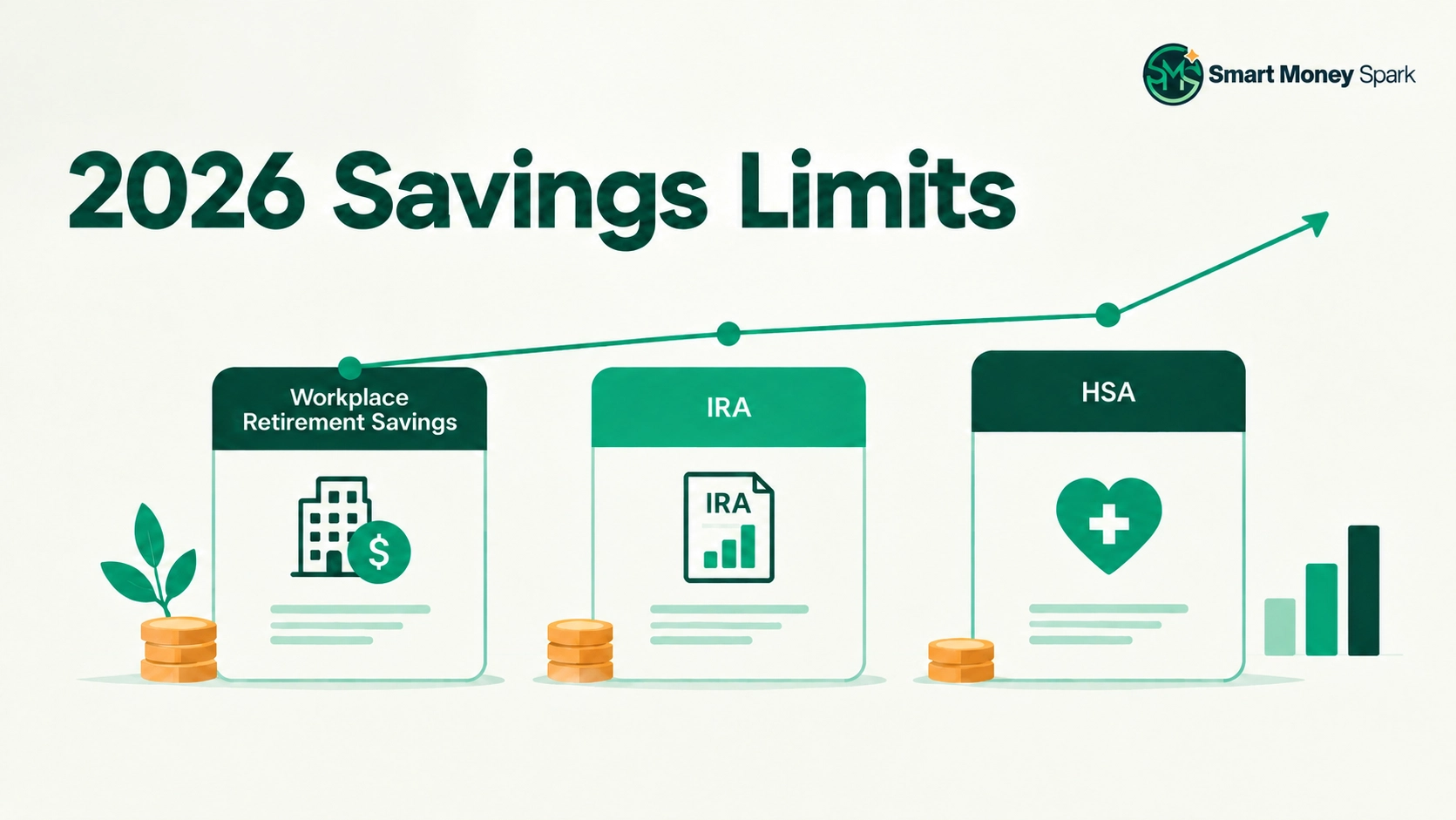
Three tax-advantaged account types can help you save for retirement and health costs in 2026.
If you’re reviewing your savings in Q4, the 2026 contribution limits can help you decide what to do with your remaining paychecks. The key is to know which limits apply to you, how much you’ve already contributed, and whether a contribution will actually be deductible.
Here are the current limits, practical year-end steps, and common mistakes to avoid.
1. Statutory COLA Adjustments: IRS Notice 2025-67 & Headline Thresholds
The IRS set many retirement plan and IRA limits for 2026 in Notice 2025-67. “COLA” means cost-of-living adjustment; some limits change over time to account for inflation.
Here are the main figures:
| Account or plan | 2026 limit |
|---|---|
| 401(k), 403(b), most governmental 457(b) plans | $24,500 employee deferral |
| 401(k)-type catch-up, generally age 50+ | $8,000 extra |
| Enhanced workplace catch-up, ages 60–63 | $11,250 extra |
| Traditional and Roth IRAs combined | $7,500 |
| IRA catch-up, age 50+ | $1,100 extra |
| HSA, self-only HDHP coverage | $4,400 |
| HSA, family HDHP coverage | $8,750 |
| HSA catch-up, age 55+ | $1,000 extra |
A “deferral” is money you direct from your paycheck into a workplace plan. Employer contributions usually don’t count toward your personal $24,500 deferral limit, but they do count toward a separate overall plan limit.
2. Workplace Defined Contribution Plans: Navigating the $24,500 Elective Deferral
For most 401(k), 403(b), and governmental 457(b) plans, the 2026 employee limit is $24,500. Your plan may set a lower limit, and plan terms determine whether it offers catch-up contributions.
If you want to max out your 401(k) late in 2026, subtract your year-to-date contributions from the amount you’re eligible to defer. Then divide what’s left by the number of paychecks remaining. For example, if you have $6,000 left and three paychecks, you’d need to defer $2,000 from each, if your plan and pay allow it. Check whether your employer match depends on contributing each paycheck or includes a year-end “true-up.”
Limits generally aggregate across plans, but the rules vary by plan type. For example, a 401(k) and 403(b) generally share the employee deferral limit, while eligible governmental 457(b) plans have a separate limit. If you have multiple plans or changed jobs, ask each plan administrator how your contributions are counted.
The overall annual additions limit for contributions to a defined contribution plan is generally $72,000 in 2026, or 100% of eligible compensation if lower. This includes employee deferrals (excluding catch-ups), employer matching and other employer contributions. This limit applies to plans maintained by one employer and related employers; it is not the same as your individual salary-deferral limit.
Before locking in your final payroll deduction adjustments, decide the order you will fund your accounts in, since the tax treatment of each one differs.
3. SECURE 2.0 Enhanced Catch-Up Tiers: The Special Bracket for Ages 60–63
If your plan allows catch-ups, workers age 50 or older can generally contribute an extra $8,000 to most 401(k), 403(b), and governmental 457(b) plans in 2026. That brings the potential employee deferral to $32,500.
A larger catch-up applies if you turn 60, 61, 62, or 63 during 2026: $11,250 instead of $8,000. That makes the potential total $35,750. It is an age-specific limit, not a catch-up available to everyone over 50.
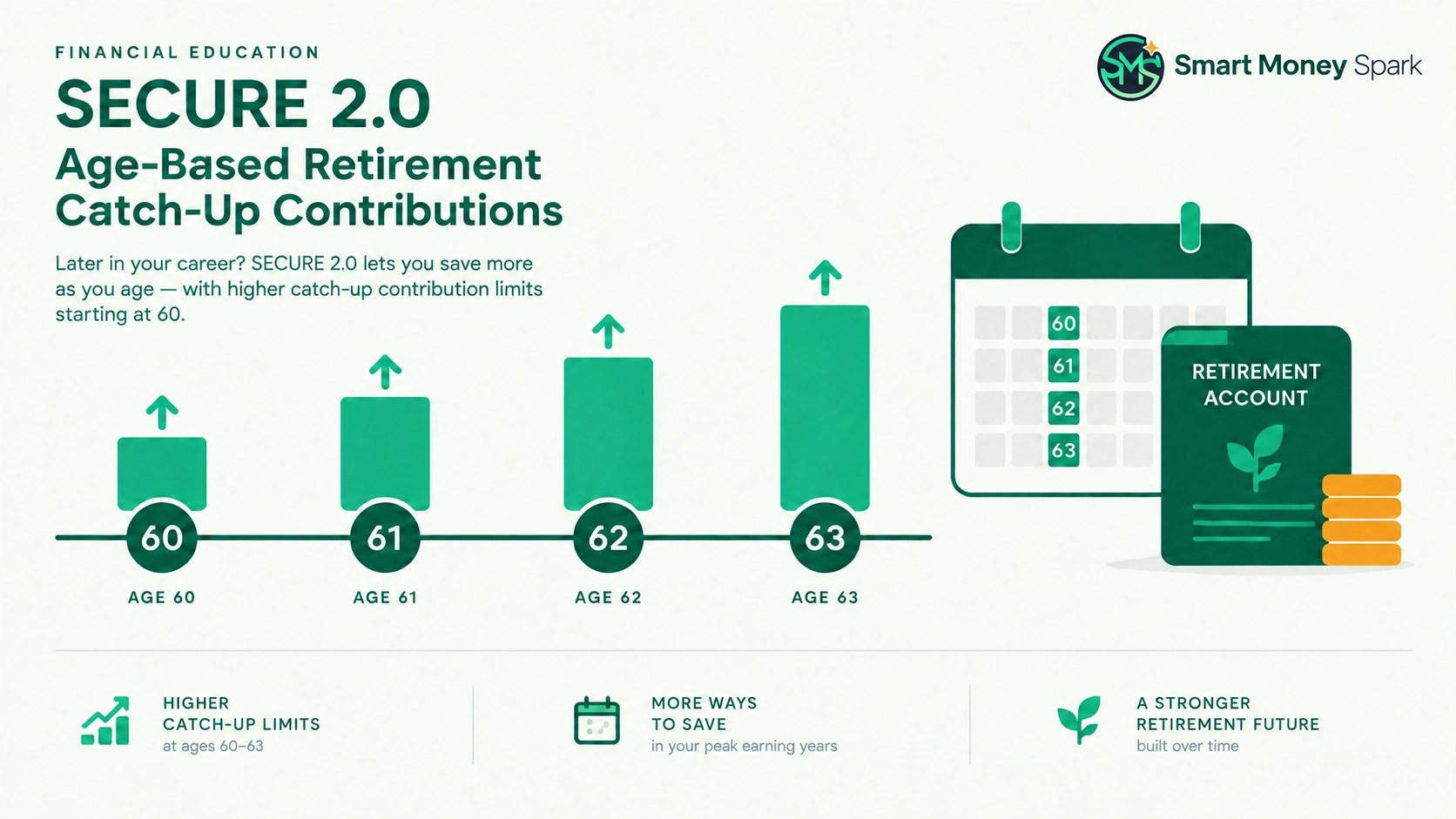
The enhanced workplace-plan catch-up applies to eligible participants who reach age 60–63 during the year.
One more tax detail: for 2026, catch-up contributions generally must be Roth contributions if your 2025 wages from the employer sponsoring the plan were above $150,000. Roth contributions are made after tax, unlike traditional pre-tax deferrals. Confirm the rule and your plan’s process with the plan administrator.
4. Traditional vs. Roth IRAs: Income Phase-Outs & Backdoor Conversions
The 2026 limit for traditional and Roth IRAs is $7,500 combined, not $7,500 for each account. If you’re 50 or older, you may contribute up to an additional $1,100, subject to taxable compensation rules.
A traditional IRA contribution may be deductible, depending on your income and whether you or your spouse is covered by a workplace plan. For single filers covered by a workplace plan, the deduction phases out between $81,000 and $91,000 of modified adjusted gross income (MAGI). For married couples filing jointly where the contributing spouse is covered, it phases out between $129,000 and $149,000. Different limits apply when only a spouse is covered.
For Roth IRA contributions, the 2026 income phase-out is $153,000–$168,000 for single filers and $242,000–$252,000 for married couples filing jointly. MAGI means a tax-return income measure with certain adjustments. Check the IRS rules for your filing status before contributing.
A backdoor Roth is a process some high earners use: make a nondeductible traditional IRA contribution, then convert it to a Roth IRA. It can create a tax bill if you have pre-tax money in traditional, SEP, or SIMPLE IRAs. The “pro-rata rule” combines those IRA balances to determine what part of a conversion is taxable. Report nondeductible basis and conversion details on Form 8606.
If your income exceeds the phase-out thresholds, a backdoor Roth is worth researching, and the pro-rata rule on Form 8606 is where most mistakes happen.
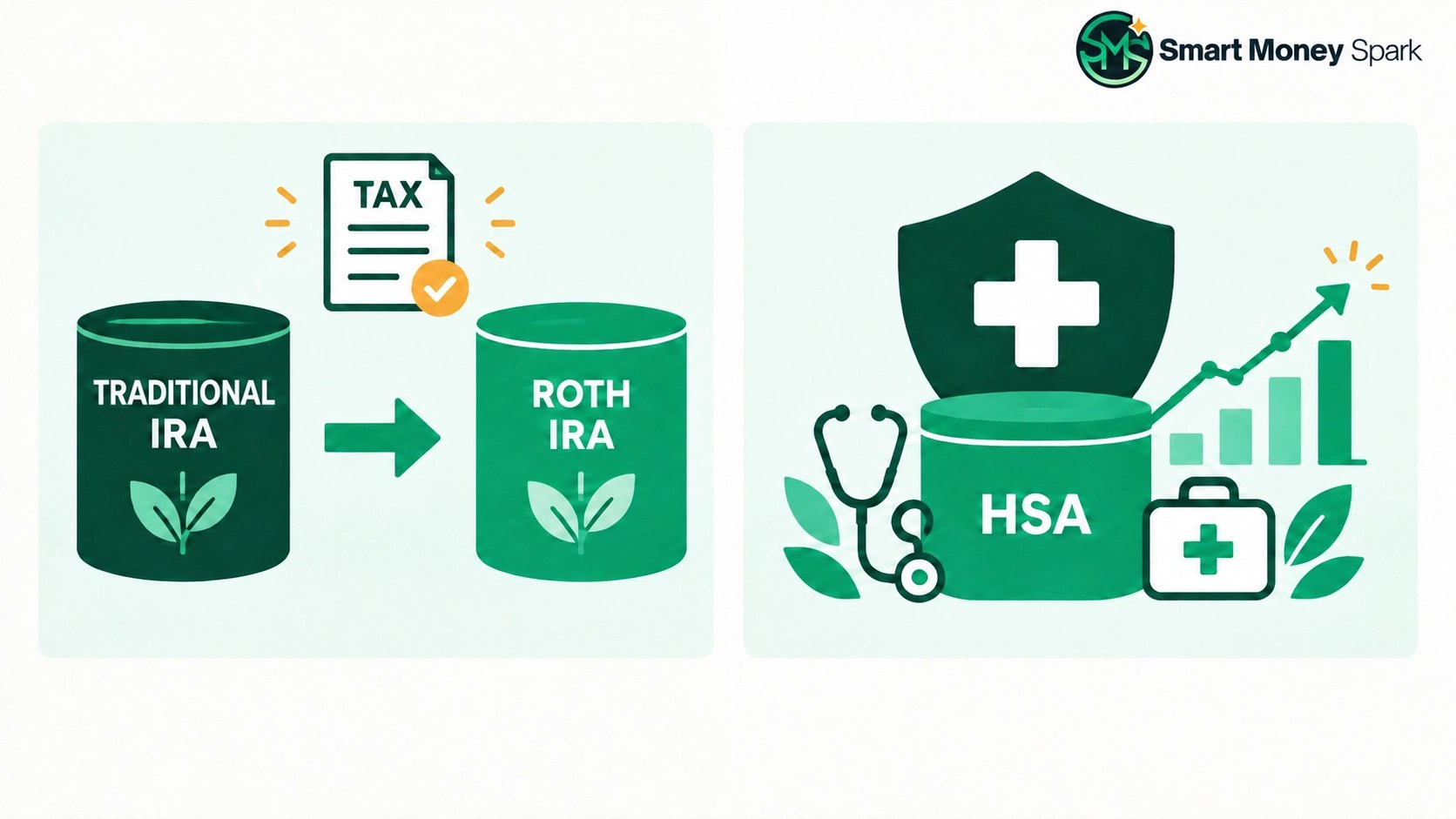
An IRA conversion and an HSA serve different purposes, and each has its own tax rules.
5. Health Savings Accounts (HSAs): The Triple-Tax Exemption Threshold ($4,400 / $8,750)
To contribute to a health savings account, you generally need qualifying high-deductible health plan coverage and must meet other eligibility rules. The 2026 contribution limit is $4,400 for self-only coverage or $8,750 for family coverage, plus $1,000 if you’re 55 or older.
These limits include contributions from you and your employer combined. An HSA’s “triple-tax advantage” means eligible contributions may be pre-tax through payroll or tax-deductible, investment growth can be tax-free, and withdrawals for qualified medical expenses can be tax-free. Nonqualified withdrawals may be taxable and, in some cases, subject to an additional tax.
Rather than using your health balance as a short-term reimbursement bucket, consider investing the balance and paying medical costs out of pocket when you can. That turns medical reserves into a secondary retirement account.
6. Prohibited Traps: Excess Deferral Penalties (IRC § 4973) & Aggregation Rules
A 401(k) excess deferral and an excess IRA contribution are different problems. Excess 401(k) deferrals are generally governed by IRC § 402(g), not IRC § 4973. If you contributed too much across applicable workplace plans, contact the plan administrator promptly and ask about a corrective distribution.
The usual deadline to distribute a 2026 excess deferral, plus allocable earnings, is April 15, 2027. A timely correction generally avoids taxing the excess twice. The deadline isn’t extended if you extend your tax return.
IRC § 4973 generally imposes a 6% excise tax each year an excess IRA contribution remains. If you discover you’ve over-contributed to an IRA, contact your IRA custodian or a tax professional about correcting it by the applicable tax-return deadline, including any required removal of earnings. Don’t assume that an IRA conversion itself is an excess contribution; the details matter.
Year-End Tax Shelter Calculation: Maximizing an Individual $36,400 Deduction Package
Here’s the requested base-case arithmetic for a saver under 50 who has eligible workplace-plan and self-only HSA coverage:
| Account | 2026 contribution limit | Possible tax treatment |
|---|---|---|
| 401(k) employee deferral | $24,500 | Pre-tax deferrals may reduce current taxable income; Roth deferrals are after-tax |
| Traditional or Roth IRA | $7,500 | Traditional IRA may be deductible; Roth contributions are after-tax |
| HSA, self-only coverage | $4,400 | Eligible contributions may be pre-tax or deductible |
| Total potential contributions | $36,400 | Not necessarily a $36,400 tax deduction |
This is an illustrative contribution total, not a promise of a deduction or a recommendation. Deductibility depends on your income, plan type, filing status, HSA eligibility, and whether contributions are pre-tax or Roth.
Catch-up variations: An eligible participant age 50 or older may have a workplace limit of $32,500 ($24,500 + $8,000) and an IRA limit of $8,600 ($7,500 + $1,100). For someone reaching age 60–63 in 2026, the workplace limit may be $35,750 ($24,500 + $11,250). An eligible HSA owner age 55 or older may add $1,000 to the applicable HSA limit. Plan rules and eligibility requirements apply.
Key takeaways
- The 2026 employee deferral limit is $24,500 for most 401(k), 403(b), and governmental 457(b) plans.
- The enhanced $11,250 catch-up is limited to eligible participants reaching age 60–63 during 2026.
- The $7,500 IRA limit is shared between traditional and Roth IRAs.
- HSA limits are $4,400 for self-only and $8,750 for family coverage; employer contributions count toward them.
- Check for excess contributions and correct them under the rules for the specific account.
Next step: Review your latest pay stub and retirement account statements, calculate your remaining 2026 contribution room, and contact your plan administrator before changing payroll deductions.
This article is educational information, not individualized tax or financial advice.
Sources: IRS 2026 limit announcement, IRS 401(k) contribution limits, IRS IRA contribution limits, IRS Revenue Procedure 2025-19 (2026 HSA limits), and IRS guidance on excess 401(k) deferrals.