

Roth and Traditional IRAs both offer tax advantages for retirement savings, but at different times.
A Roth IRA is often a strong fit if you expect your tax rate to be higher later, or want more flexibility with withdrawals. A Traditional IRA may suit you better if you can deduct your contribution now and expect a lower tax rate in retirement.
Neither account wins for everyone. The better choice depends on your current tax situation, expected retirement income, eligibility, and how much you value access to your contributions.
What's the actual difference?
The main difference is when you pay income tax. With a Traditional IRA, contributions may be deductible now, and you generally pay tax when you withdraw the money. Investment growth is tax-deferred, meaning you generally don’t owe tax on it until you take money out.
With a Roth IRA, you contribute money you’ve already paid tax on. You don’t get a deduction for the contribution, but qualified withdrawals, including investment growth, are tax-free.
| Feature | Traditional IRA | Roth IRA |
|---|---|---|
| Tax treatment going in | Contributions may be deductible, depending on income and workplace-plan coverage | Contributions aren’t deductible |
| Tax treatment coming out | Withdrawals are generally taxed as ordinary income | Qualified withdrawals are tax-free |
| 2026 contribution limit | $7,500; $8,600 if age 50 or older | $7,500; $8,600 if age 50 or older |
| Income phase-outs | May limit the deduction; contribution eligibility generally has no income cap | Income limits can reduce or prevent direct contributions |
| Required minimum distributions (RMDs) | Generally required during the owner’s lifetime | No lifetime RMDs for the original owner |
| Early withdrawal rules | Tax and usually a 10% additional tax before age 59½, unless an exception applies | Regular contributions can generally be withdrawn tax- and penalty-free; earnings have rules |
| May fit best if… | You want a possible deduction now and expect a lower tax rate in retirement | You want tax-free qualified withdrawals and value flexibility |
Roth earnings are tax-free only when a withdrawal is “qualified”. Generally, you’ve met the five-year rule and are at least 59½, or meet another qualifying condition. Traditional IRA withdrawals before 59½ generally face income tax plus a 10% additional tax, though exceptions apply. See the IRS’s IRA distribution rules.
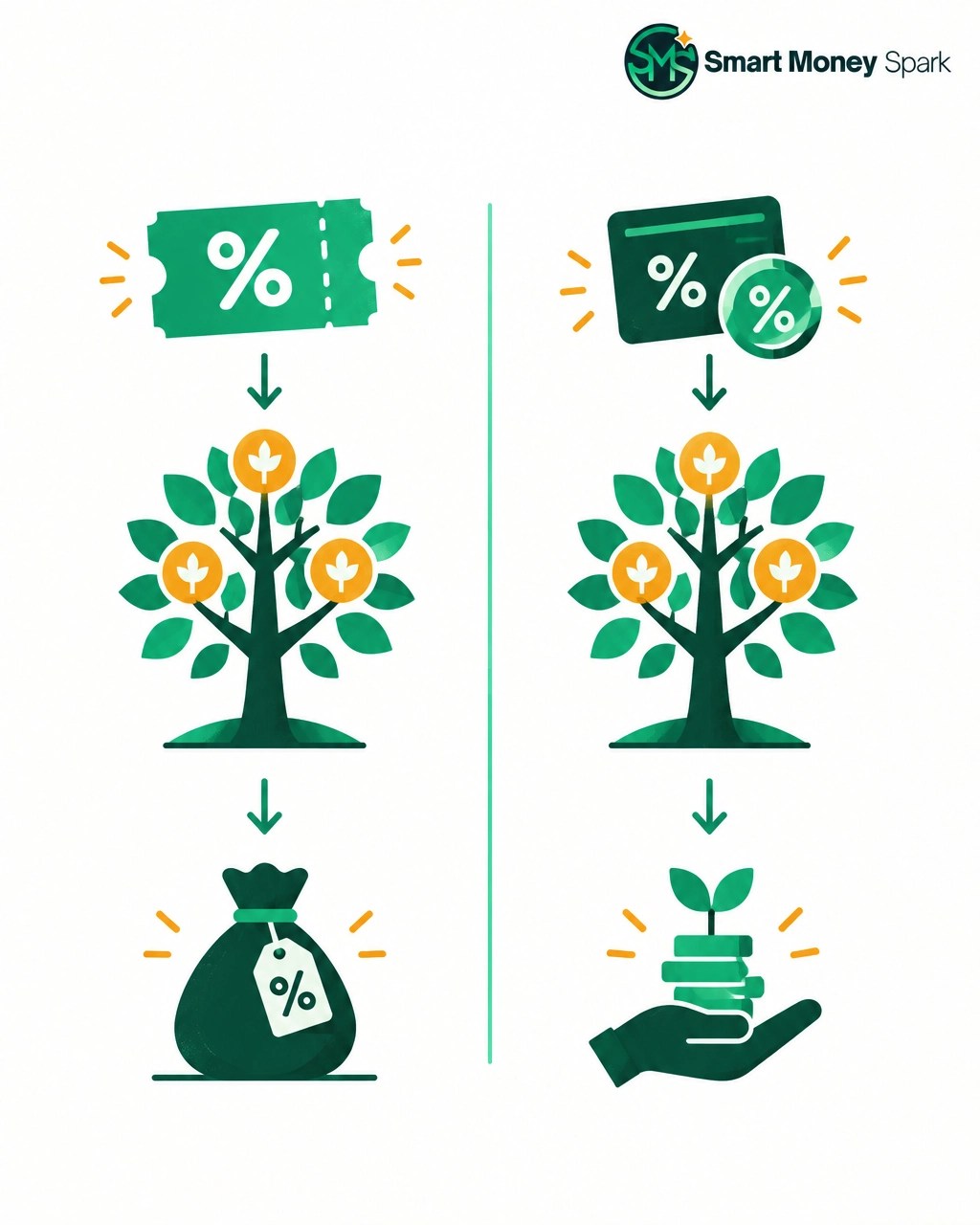
The Roth generally shifts taxes to today; the Traditional IRA may shift them to retirement.
Which one saves you more in taxes?
It depends on your tax rate now compared with your tax rate when you withdraw the money.
A deductible Traditional IRA contribution can lower your taxable income today. If you’re in a high tax bracket now and expect a lower one in retirement, that deduction may be valuable. But withdrawals are generally taxable, so you’re postponing the tax bill rather than avoiding it.
A Roth offers the reverse trade-off: pay tax now, then take qualified withdrawals tax-free. If your tax rate is lower today than you expect it to be later, paying tax upfront may work in your favor.
A $7,000 example
Suppose you contribute $7,000 and are in a 24% federal tax bracket today. A deductible Traditional IRA contribution could reduce your federal income tax by about $1,680 that year ($7,000 × 24%). A Roth contribution does not provide that deduction.
For a simple illustration, assume the $7,000 grows for 25 years at an average annual return of 6%, with no fees. The growth rate is only an example, not a forecast.
| Account | Value after 25 years, before withdrawal tax | Tax at a hypothetical 24% withdrawal rate | Approximate amount left from IRA |
|---|---|---|---|
| Traditional IRA | $30,000 | $7,200 | $22,800 |
| Roth IRA | $30,000 | $0, if the withdrawal is qualified | $30,000 |
This compares the IRA balances only; it does not include what happens to the Traditional IRA’s estimated $1,680 tax savings today. If you invest that tax savings, your overall result changes. The example also assumes a steady return and the same 24% tax rate at withdrawal, so it can’t predict which account will work better for you.
What are the 2026 contribution limits and income limits?
For 2026, the total you can contribute to all your Traditional and Roth IRAs combined is $7,500, or $8,600 if you’re age 50 or older. You generally can’t contribute more than your taxable compensation for the year. The limit is shared. You can’t put $7,500 in each type of IRA.
Roth eligibility and the deductibility of Traditional IRA contributions can depend on your MAGI, or modified adjusted gross income. MAGI is an IRS-adjusted version of your income used to apply certain tax rules. A phase-out is an income range where an allowed deduction or contribution gradually shrinks.
| 2026 rule | Income range |
|---|---|
| Roth IRA contribution phase-out: single or head of household | $153,000–$168,000 MAGI |
| Roth IRA contribution phase-out: married filing jointly | $242,000–$252,000 MAGI |
| Traditional IRA deduction phase-out: covered by a workplace plan, single or head of household | $81,000–$91,000 MAGI |
| Traditional IRA deduction phase-out: covered by a workplace plan, married filing jointly | $129,000–$149,000 MAGI |
| Traditional IRA deduction phase-out: not covered by a workplace plan, but spouse is, married filing jointly | $242,000–$252,000 MAGI |
Within a phase-out range, the eligible amount is gradually reduced; at or above the top of the range, it may be unavailable. If neither you nor your spouse is covered by a workplace retirement plan, the Traditional IRA deduction phase-outs generally don’t apply. Other filing situations, including married filing separately, have separate rules.
For details, check the IRS’s 2026 IRA limit announcement and Publication 590-A.

Income can affect Roth contribution eligibility and whether a Traditional IRA contribution is deductible.
When does a Roth win?
A Roth may be a better fit if you expect your tax rate to be higher in retirement than it is today. That can be a consideration if you’re early in your career or currently in a lower tax bracket, though future tax rates and income are hard to predict.
It may also suit you if you value flexibility. You can generally withdraw your regular Roth contributions at any time without income tax or penalty. That rule does not apply in the same way to investment earnings, which have additional requirements.
Another Roth feature: the original account owner doesn’t have to take lifetime RMDs. Traditional IRAs generally require withdrawals starting at age 73 under current rules.
When does a traditional win?
A Traditional IRA may make sense if you qualify for a deduction now and believe your tax rate will be lower when you take withdrawals. The deduction may also help if reducing this year’s taxable income is a priority.
Keep in mind, the deduction isn’t automatic. Workplace-plan coverage and income can affect how much you can deduct, and withdrawals are generally taxable. If you make a nondeductible Traditional IRA contribution, special tax reporting rules apply.
Can you have both?
Yes. You can have both types of IRA and contribute to both in the same year, as long as you meet the eligibility rules. But your contributions across both accounts share the same 2026 limit: $7,500, or $8,600 if you’re 50 or older.
Having both can give you different tax options later. Just make sure your combined contributions stay within the limit and your Roth contribution amount is allowed based on your income.
How do you decide? (the simple rule of thumb)
Start with three questions:
- Can you deduct a Traditional IRA contribution? Check your filing status, MAGI, and whether you or your spouse is covered by a workplace plan.
- What tax rate do you expect in retirement? You can’t know for sure, but consider likely income from work plans, pensions, Social Security, and other savings.
- How important is access and withdrawal flexibility? Roth contributions are generally more accessible, but pulling them out can still reduce money available for retirement.
As a rough guide, choose Roth if paying tax now seems preferable to paying tax later and you value tax-free qualified withdrawals. Consider Traditional if the deduction is available and you expect your tax rate to be lower in retirement. If you’re unsure, a tax professional can help you compare the effect on your full tax return.
For a plain-English walkthrough of opening your first Roth IRA, our beginner’s guide covers it step by step.

Your tax rate, income eligibility, and need for flexibility can help guide the choice.
Roth IRA vs Traditional IRA FAQs
Can I contribute to both a Roth and a Traditional IRA?
Yes, if you meet the rules for each account. Your combined contributions count toward one annual limit, not a separate limit for each IRA.
What happens if my income goes over the Roth IRA limit?
Your allowed direct Roth contribution may be reduced or unavailable, depending on your MAGI and filing status. Check the IRS rules before contributing. Contributing too much can lead to additional tax unless corrected under the rules.
Is a Roth IRA tax-free?
Not entirely. You contribute after-tax money, and qualified withdrawals are tax-free. Investment earnings taken out before meeting the qualification rules may be taxable and could face an additional tax.
Can I withdraw Roth IRA contributions at any time?
You can generally withdraw regular contributions without tax or penalty. Earnings and certain converted amounts have different rules, so don’t assume every Roth withdrawal is tax-free.
Do I have to take RMDs from a Roth IRA?
The original Roth IRA owner does not have to take lifetime RMDs. Beneficiaries may have required withdrawals after the owner’s death.
Smart Money Spark’s financial education is informed by Corey Friedrich’s background in mortgage, real estate, and financial education, with a focus on practical decisions for households. This article is educational information, not individualized financial or tax advice.
Key takeaways
- Roth IRAs use after-tax contributions; qualified withdrawals are tax-free.
- Traditional IRA contributions may be deductible, but withdrawals are generally taxable.
- The 2026 limit is $7,500, or $8,600 if you’re 50 or older, shared across both IRA types.
- Income can affect Roth contribution eligibility and Traditional IRA deductibility.
- Roth contributions are generally more accessible than Traditional IRA funds, but Roth earnings have separate withdrawal rules.
Next step: Check your 2026 MAGI, workplace-plan coverage, and likely retirement tax bracket before contributing. For more financial education, visit Smart Money Spark.