
A single CD makes you decide everything at once: one rate, one end date, and the whole balance locked until then. A savings account goes the other way, keeping the cash available while the rate drifts down whenever the bank changes it. A cd ladder tries to sit in the middle, and it asks you to do one thing a single CD never does, which is show up at every maturity and decide again.
So what is a cd ladder, exactly? It splits your money across several CDs with staggered end dates, so part of your cash becomes available on a schedule while the rest keeps its fixed rate. A certificate of deposit (CD) is a bank deposit that pays an agreed rate for a set term, usually with a penalty if you take the money out early.
What's the actual difference between the three approaches?
A ladder sits between those two extremes. It does not raise your rate by magic, and it does not leave every dollar reachable on a Tuesday afternoon. What it buys you is a schedule.
| Approach | Access to money | Rate certainty | Decisions required |
|---|---|---|---|
| CD ladder | A portion becomes available at each scheduled end date | Fixed for each CD’s term | Decide whether to use or reinvest each portion |
| One CD | Usually available at one end date; early access may incur a penalty | Fixed for the full term | Choose the term once, then decide what to do at the end |
| All in savings | Generally accessible without waiting for a CD to end | Variable; the bank can change the rate | Monitor the rate and decide whether it still suits you |
How does a CD ladder actually work?
You divide your deposit among CDs with different terms. Each CD is a “rung” of the ladder. A maturity is the date a CD’s term ends and the bank returns your deposit, along with any interest due under the account terms.
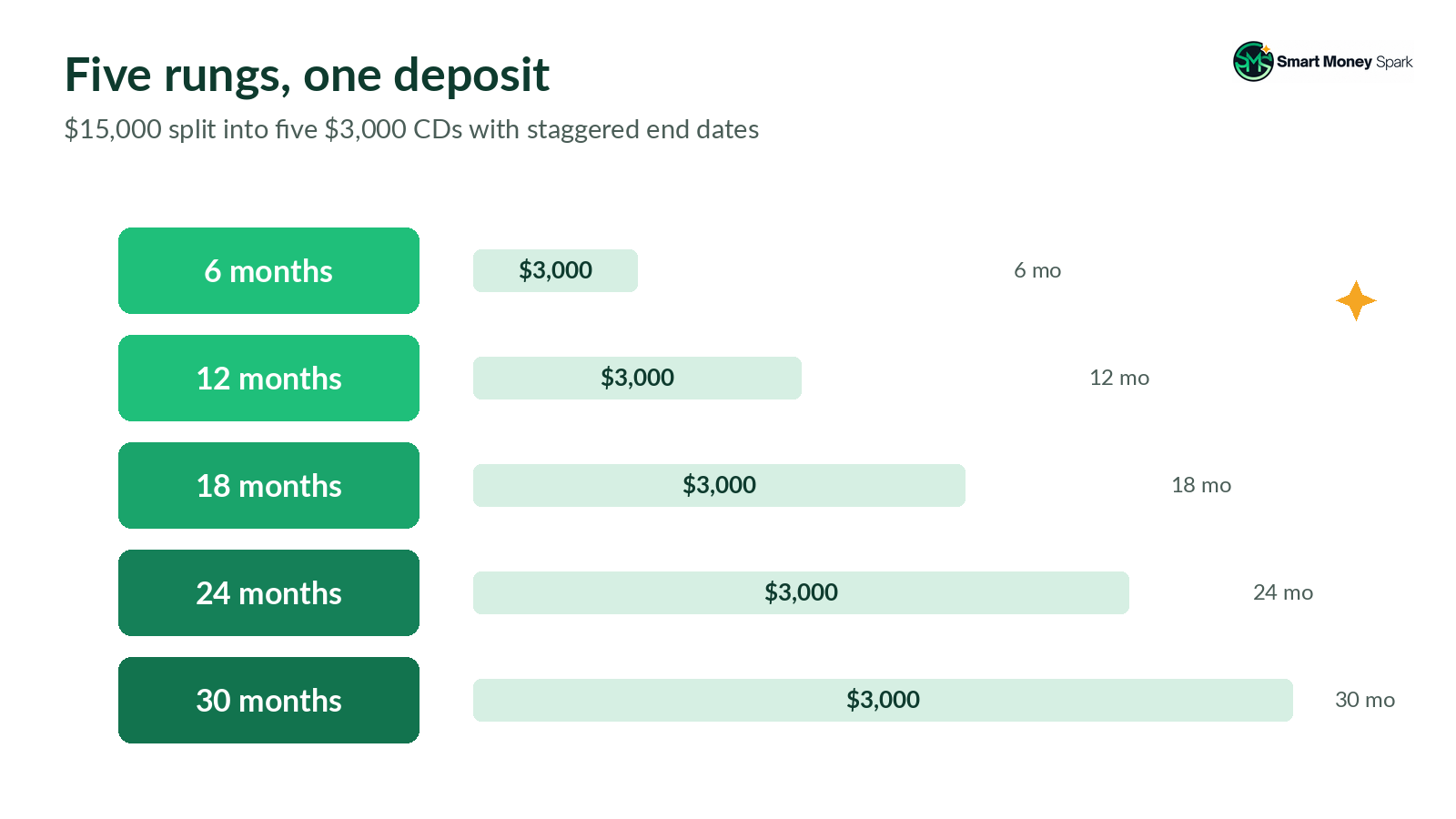
For example, instead of putting $15,000 into one 30-month CD, you could open five CDs with different maturity dates. Each one locks in its own rate, and one comes due at regular intervals. At that point, you can spend the proceeds or reinvest them.
The spacing is what matters, not the number of rungs. Five CDs arriving six months apart are useful. Five CDs arriving within a few weeks of each other are just a single CD with extra paperwork.

The ladder does not make a CD’s rate higher by itself. Its purpose is to spread out when your money is locked up, rather than making you choose one maturity date for the whole balance.
What happens in a $15,000 ladder?
Here is a worked example with five $3,000 CDs. The rates below are illustrative simple-interest assumptions, not current offers; the calculation ignores compounding. Each original CD matures at a different six-month point.
| CD term | Illustrative rate | Simple interest at maturity |
|---|---|---|
| 6 months | 4.00% | $60 |
| 12 months | 4.10% | $123 |
| 18 months | 4.20% | $189 |
| 24 months | 4.30% | $258 |
| 30 months | 4.40% | $330 |
| Total over 30 months | $960 |
At month six, the first $3,000 CD matures. You can use the $3,060 in principal and interest, or put the principal into a new 30-month CD. At month 12, the next original CD matures; again, use the cash or reinvest it in a new 30-month CD.
Continue that choice each time another rung matures. Rolling each maturing principal into a new longest-term CD keeps the ladder going, with another portion coming due every six months. If you need the money instead, you can take it rather than extend the ladder.
How does the ladder compare with one 30-month CD?
Putting the entire $15,000 into one 30-month CD at the same illustrative 4.40% simple-interest rate would earn about $1,650 over 30 months. That is roughly $690 more than the ladder’s $960 in the example.
The difference comes from the ladder placing some of the money in shorter-term CDs that earn lower assumed rates. In return, you get regular maturity dates instead of locking the whole balance until month 30. That $690 is the illustrative price of having scheduled access, not proof that using a ladder is a mistake. If you know you will not need any of the cash before month 30, a single CD at a competitive rate may be the simpler, higher-earning choice.
A ladder also keeps working only if you keep feeding it. Take every maturity as cash and you end up with closed accounts and no schedule. The rollover is the part people skip.
What if you keep the money in savings?
At an illustrative 3.50% simple rate, $15,000 in savings would earn about $1,312.50 over 30 months, if the rate held for the whole period. The difference versus the ladder’s $960 would be $352.50, but a savings rate is variable and can fall. The ladder locks each CD’s rate for that CD’s term, though future rates on any reinvested rungs are unknown.

If flexibility is your priority, savings may suit you better even if its rate changes. If you want to compare other places for short-term cash, see our comparison of brokerage cash sweeps and high-yield savings. For a different set of short-term options, read our comparison of ultra-short Treasury options.
What do current CD rates tell you?
The FDIC’s November 2026 national averages, revised November 16, were 0.23% for a 1-month CD, 1.14% for 3 months, 1.40% for 6 months, 1.81% for 12 months, 1.60% for 24 months, 1.42% for 36 months, 1.33% for 48 months, and 1.44% for 60 months. These are deposit-weighted national averages, not a shopping list of offers. APY, or annual percentage yield, is the yearly rate that reflects the effect of compounding.
On November 23, 2026, the Wall Street Journal Buy Side reported the average for top high-yield CDs at 4.94%, per DepositAccounts.com, with best nationwide APYs ranging from 4.50% to 5.10%. Offers vary by institution, term, minimum deposit, and eligibility, so compare actual terms before opening an account.
The Treasury yields used in the FDIC’s rate-cap calculation were 4.36% at 12 months, 4.56% at 24 months, and 4.65% at 36 months. That upward slope helps explain why longer rungs can pay more in some current offers, though not every CD rate follows the same pattern. It also highlights reinvestment risk: the chance that, when a CD matures, you can only reinvest at a lower rate than before.
What are the real downsides?
Early withdrawal penalties: Federal law sets a minimum penalty of seven days of simple interest if you withdraw within the first six days after deposit. After that, the bank sets its own disclosed penalty, commonly three to six months of interest depending on the CD term. Check the account terms before opening.
Reinvestment risk: When a rung matures, rates may be lower than when you first opened it. If you roll the money into a new CD, that portion could earn less going forward.
Limited access at first: A ladder does not give you instant access to every dollar. If an emergency hits before the first rung matures, you may need other savings or to break a CD and pay a penalty. Liquidity means how easily you can reach money without delay or penalty.
Insurance limits: FDIC insurance is federal protection for eligible deposits if an insured bank fails. Coverage is $250,000 per depositor, per FDIC-insured bank, for each account ownership category; if you hold a large balance at one bank, your CDs count alongside your other deposits in the same category.
When does a ladder win?
A ladder fits when you want predictable access dates, prefer to lock rates on portions of your balance, and do not know exactly when you will need all the money. It also saves you from choosing one perfect term for the whole deposit.
When does one CD win?
One CD may be the better fit when you are confident you will not need the cash before a specific date, want fewer accounts to manage, and find a competitive rate for that exact term. Make sure your emergency cash is separate before locking away the balance.
How should you decide?
Ask yourself:
- When might you need this money, and how much should stay immediately accessible?
- Does a single CD offer a meaningfully better rate for a term you can comfortably hold?
- Are you willing to make a reinvest-or-spend decision at each maturity?
Rule of thumb: Keep near-term spending and emergency money accessible; consider a ladder for cash you can commit in portions; choose one CD when you are comfortable locking the full amount to one date.
CD ladder questions
Does a CD ladder guarantee a higher return?
No. A ladder structures access dates; it does not guarantee the best rate. Your result depends on the rates available for each rung and on what you do when each one matures.
Can I withdraw money from a CD ladder early?
Usually, you can request an early withdrawal, but the bank may charge its disclosed penalty. A ladder gives you scheduled maturity dates; it does not make every rung penalty-free to break early.
What should I do when a rung matures?
Use the cash if you need it, or compare current offers and reinvest the principal in a new longest-term CD. Check whether the bank automatically renews CDs and how long you have to change that instruction.
How much should I put in a CD ladder?
Start with money you do not expect to need before the CDs mature. Keep a separate accessible reserve, and check total deposits at each bank against FDIC coverage limits.
Key takeaways
- A CD ladder staggers maturity dates so portions of your money become available on a schedule.
- A single CD may earn more when its rate is competitive and you can leave the full balance untouched.
- Savings offers easier access, but its rate can change.
- Compare actual APYs and account terms; national averages are not specific offers.
- Plan for penalties, lower future rates, and FDIC coverage limits.
Next step: Decide how much cash must remain accessible, then compare current CD offers for terms that match the amount and timing you can commit.
This is educational information, not individualized financial advice.
Sources: FDIC National Rates and Rate Caps, November 2026; FDIC deposit insurance; FDIC HelpWithMyBank CD penalties; WSJ Buy Side CD rates, November 23, 2026.