
Ask about emergency fund how much to save and you usually hear the same answer: three to six months of expenses, repeated as if it were settled. It is a reasonable starting point, but it skips the thing that actually decides your number, which is how long it might take you to replace your income.
The plain-English answer: your target should reflect how long it could take you to replace your income and keep up with essentials, not just follow a formula. An emergency fund is money set aside for unexpected bills or a loss of income.
What is the fund actually for?
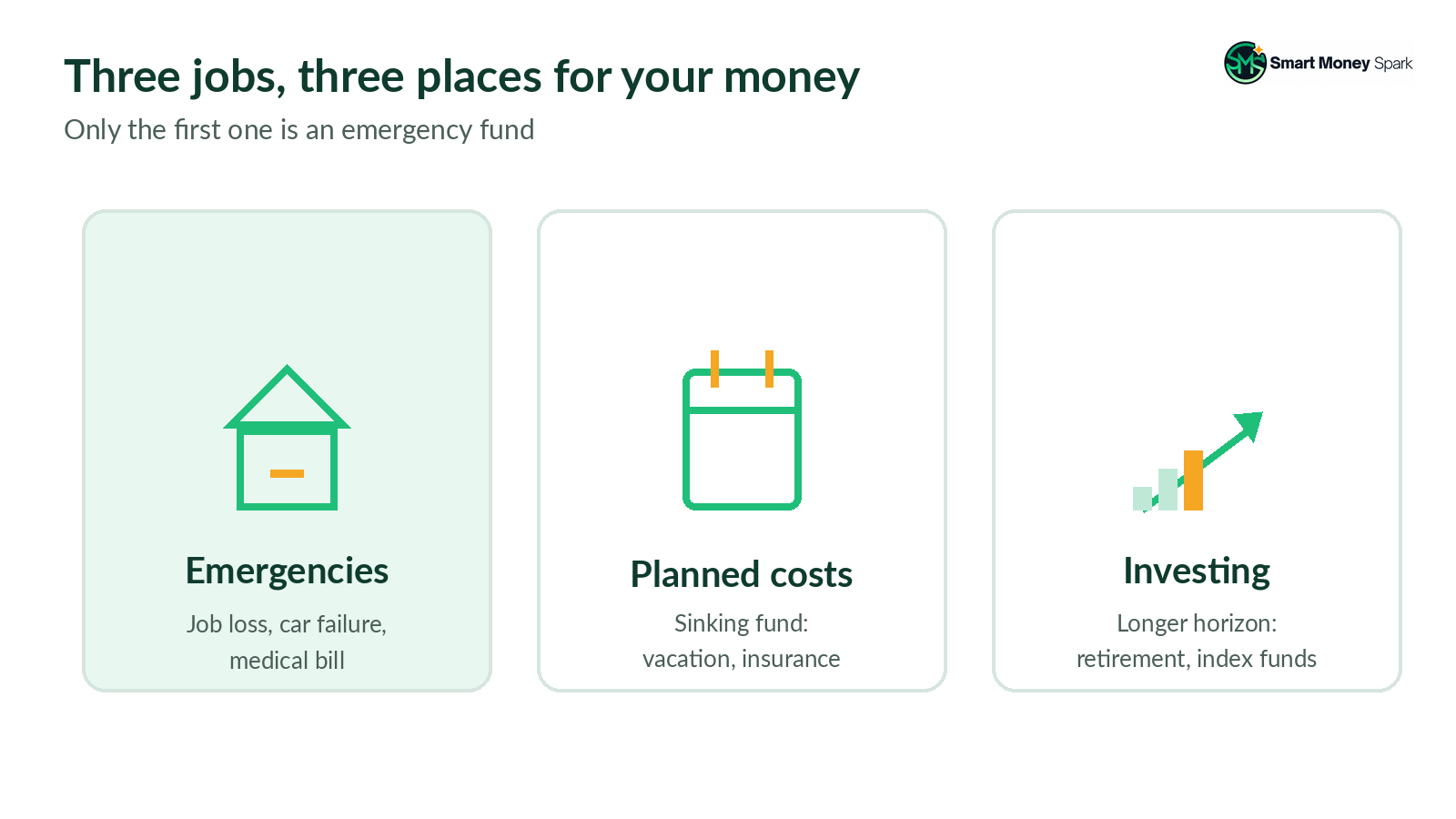
It exists for the things you cannot schedule: a layoff, a transmission that fails on a Tuesday, a medical bill your plan does not fully cover, a water heater that gives out in January. Those events share one trait, which is that they arrive without warning and need cash quickly.
A sinking fund is money you save in advance for a planned expense, and it is the answer for everything you can see coming. A vacation, an annual insurance premium, new tires next spring: all predictable. Putting those in your emergency fund is how people end up with a fund that is always empty.
| Situation or goal | Emergency fund | Other savings |
|---|---|---|
| Job loss or sudden income drop | Yes | – |
| Unexpected car failure | Yes | – |
| Medical bill or urgent home repair | Yes | – |
| Planned vacation or annual insurance bill | – | Sinking fund |
| Long-term investing | – | Investment account |
How much emergency fund should you save?
Start by calculating your essential expenses: the core costs you need to keep paying, such as housing, basic food, utilities, insurance, transportation, and minimum debt payments. Use a realistic monthly amount, not your full take-home pay or every optional purchase.
Then choose a first milestone based on your income stability and how quickly you could earn again. These levels are practical starting points, not requirements.
| Savings level | A reasonable starting fit | What it can help cover |
|---|---|---|
| One month of essentials | A starter cushion or an early goal | A small setback while you adjust |
| Three months of essentials | Stable salaried work and reliable benefits | A job search or several unexpected bills |
| Six or more months of essentials | Variable income, one household earner, or slower-to-replace work | A longer income gap or several overlapping costs |
One month gives you breathing room, but it may not carry you through an extended job search. If your pay is steady and your skills are in demand, three months may be a workable target. If income is unpredictable or replacing it could take longer, a six-month or larger cushion can provide more time.

What does the target look like in dollars?
Here’s an illustrative example using $3,200 in essential monthly expenses and saving $400 each month. The timeline assumes no interest, no withdrawals, and the same monthly deposit throughout.
| Goal | Amount to save | Time at $400 per month |
|---|---|---|
| One month | $3,200 | 8 months |
| Three months | $9,600 | 24 months |
| Six months | $19,200 | 48 months |
You don’t have to wait until you reach the largest goal to benefit. In this example, the first $3,200 milestone takes eight months; after that, you can keep adding money toward three or six months. If $400 is too much right now, set a smaller automatic amount and raise it when your budget allows.

What do recent household savings figures show?
In the Federal Reserve’s 2025 Survey of Household Economics and Decisionmaking, released in May 2026, 55% of adults said they had set aside three months of expenses in an emergency fund. The same report found that 63% would cover a $400 unexpected expense with cash or its equivalent, which includes savings or a credit card paid off by the next statement.
Those figures describe households overall; they don’t establish the right target for you. The Consumer Financial Protection Bureau does not publish a months-of-expenses target. Its emergency fund guide says the right amount depends on your situation and suggests starting with unexpected expenses you have actually faced.
What could move your target higher?
Four situations come up often, and each one pushes the target above three months. None of them means you are doing something wrong; they just mean your income is harder to replace than a steady salaried job.
Commission or freelance income: When pay varies month to month, a strong month may be followed by a lean one. Consider a larger cushion, especially if you need to cover taxes, business costs, or unpaid gaps between projects.
A single-earner household: If one paycheck supports everyone, losing that income can affect the whole household at once. A larger reserve can give you more time to find work or change your budget without counting on another household income.
A specialized job market: If there are few suitable jobs nearby or a job search in your field typically takes longer, replacing your income may take time. Consider how long you could realistically be without comparable pay, not just how quickly you could take any job.
A high-deductible health plan: A high deductible can leave you responsible for more of a covered medical bill before insurance begins paying. Look at your plan’s deductible and out-of-pocket limit, along with any health savings account balance, when deciding whether you need additional cash on hand.
When does a bigger fund win?
A larger target may make sense if your income changes often, you’re the only earner, you have dependents, or you expect a long job search. It can also help if your essential costs are hard to reduce quickly, such as rent, loan payments, insurance, or regular care expenses.
The trade-off is that more cash may sit outside investments that could grow over the long term. Build protection against realistic setbacks, but don’t assume every household must keep the same amount in cash.
When does a smaller fund win?
A smaller target can be reasonable if your pay is predictable, your job is relatively easy to replace, or you have another dependable income source in the household. It may also suit you if you have low fixed costs and can quickly reduce optional spending.
A smaller goal is better than no savings goal at all. Start with one month of essentials, or an amount that would cover the unexpected expenses you’re most likely to face, and review it when your circumstances change.
Keep in mind that a smaller target trades protection for flexibility. That works when you have other real options, such as a second income, low fixed costs, or family support you could lean on without strain. It does not work if the only backup plan is a credit card.
How can you build the fund consistently?
Set an automatic transfer for payday, even if the first amount is modest. If your income varies, choose a baseline you can keep up during a slower month and add extra after stronger months.
Keep the money in a separate high-yield savings account, a savings account that pays a competitive interest rate compared with many standard savings accounts. Separate savings can make it less tempting to spend while still keeping the money available; compare rates, fees, transfer timing, and protections. For the trade-offs, see our comparison of brokerage cash sweeps and high-yield savings.
A budget can help you find an automatic amount that won’t leave checking short before bills are due. If you need a way to organize income and expenses, try our comparison of budgeting methods.
Expect to pause sometimes. A large repair or a slow month may mean skipping a transfer, and that is fine as long as the pause has an end date. The risk is letting a short pause turn into a habit, where the money you skipped quietly goes back into routine spending instead of the fund.
What should you ask before choosing a target?
Start with three questions:
- How long might it take me to replace most or all of my income?
- How much do I need each month to cover essentials, and which costs could I reduce?
- What other resources could help in an emergency, and how quickly could I access them?
Rule of thumb: Start with one month of essential expenses, work toward three months if your income is stable, and consider six or more if replacing your income could take longer or your household has less backup.
Your emergency savings should be safe and liquid, meaning you can access the money without a long delay or a large penalty. A savings account at an FDIC-insured bank may fit that purpose; check account terms and applicable FDIC deposit insurance limits. Interest earned in a savings account is generally taxable as ordinary income.
Emergency fund questions
Should I save one month or three months first?
Start with one month of essential expenses if that feels achievable, then build toward a larger amount based on your income stability and household needs. The first milestone gives you a useful buffer while you continue saving.
Should I include debt payments in essential expenses?
Include at least the minimum payments you need to make to keep accounts current. Separate essential payments from extra debt payoff, which you may be able to adjust temporarily if income falls.
Is a savings account better than investing my emergency fund?
Emergency savings are meant to be available when you need them, so a safe, accessible savings account is often a practical option. Investments can lose value, and selling during a downturn could leave you with less than you put in.
Should I use my fund for a planned expense?
Usually, save for predictable costs separately in a sinking fund. Keep emergency savings for unexpected bills or a sudden loss of income, then rebuild the balance if you need to use it.
Key takeaways
- Three to six months is a starting range, not a universal rule.
- Your target should reflect how long it may take to replace your income.
- Count essential expenses, not every dollar you usually spend.
- Build one milestone at a time and automate what you can afford.
- Keep emergency cash safe, accessible, and separate from planned spending and investments.
Next step: Write down your essential monthly expenses, choose your first milestone, and schedule an automatic payday transfer for an amount you can sustain.
This article is educational information, not individualized financial advice.
Sources: Federal Reserve SHED report · CFPB emergency fund guide · FDIC deposit insurance