
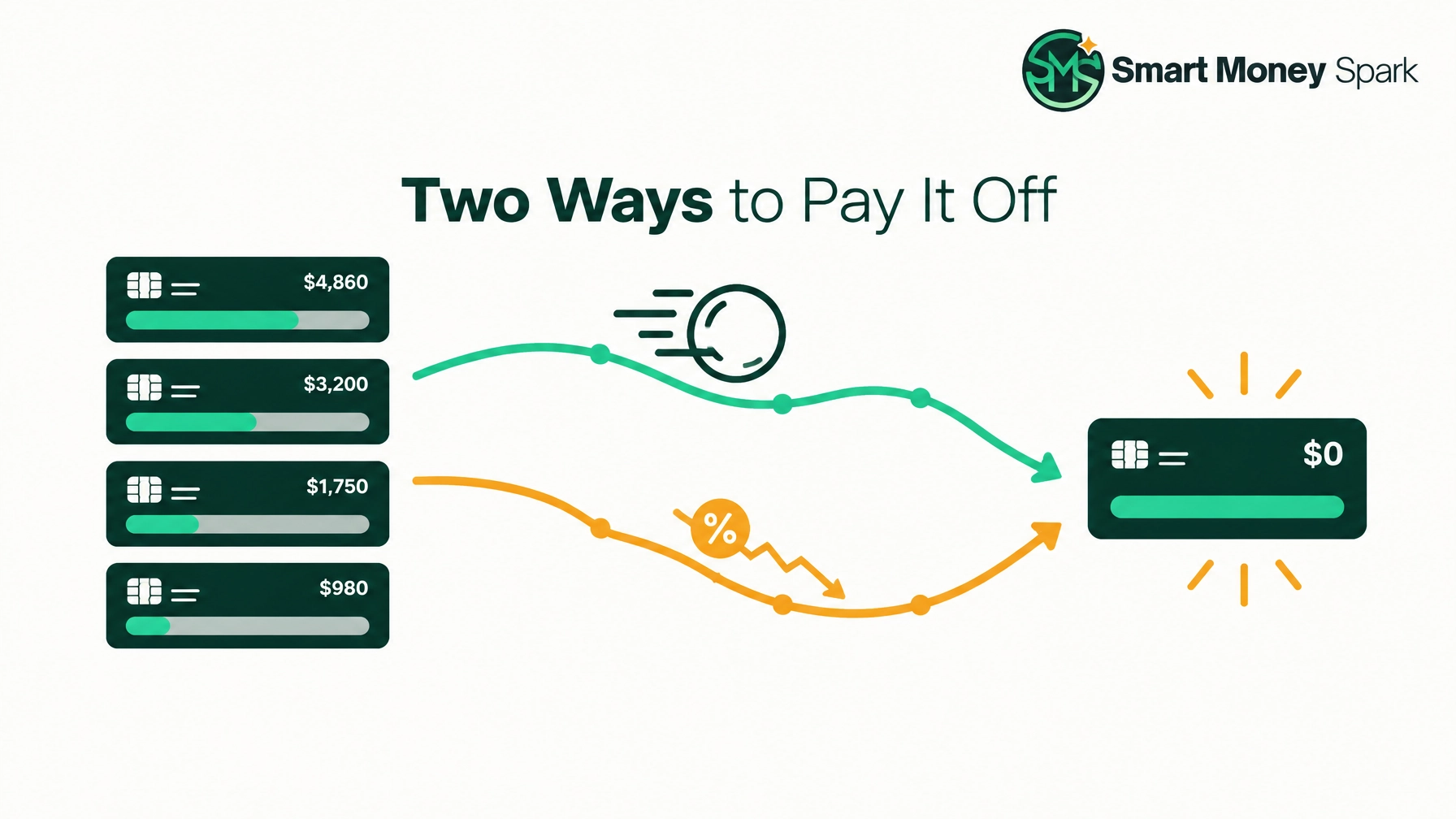
Two practical ways to turn several card balances into a clear payoff plan.
Credit card debt can feel stuck: you pay every month, but interest takes a big bite before your balance moves. The plain answer to how to make progress is to pay at least the minimum on every card, then direct all extra money to one card at a time. The two common ways to choose that target are the avalanche, which prioritizes the highest interest rate, and the snowball, which prioritizes the smallest balance.
Neither method makes a tight budget painless, but both give your extra payments a clear job. The best choice is the one you can follow while keeping up with essentials and minimum payments.
| Method | Pay extra toward… | Main advantage | Main trade-off |
|---|---|---|---|
| Avalanche | The card with the highest APR | Usually costs less interest when you stick with it | The first payoff may take longer |
| Snowball | The card with the smallest balance | A quicker early win can build momentum | May cost more if a higher-rate balance waits |
APR means annual percentage rate: the yearly rate used to calculate interest, though card interest is generally charged over shorter periods.
How to pay off credit card debt with the avalanche or snowball method
Start by listing each card’s balance, APR, minimum payment, and due date. Check for promotional rates and when they expire. Then set up at least the minimum payment on every account, ideally automatic payments, with enough money in the payment account to cover them.
Next, choose one card as your target. Pay its minimum plus as much extra as your budget allows; keep paying only the minimums on the others. When the target is paid off, move the full amount you had been paying toward the next card. The Consumer Financial Protection Bureau’s debt-reduction guidance describes both the highest-interest-rate approach and the snowball approach, including rolling the payment forward after a payoff.
Try to stop adding new purchases to the cards you’re paying down, if you can. If you still need a card for regular expenses, make a plan to pay those new charges off rather than letting them rebuild the balance.
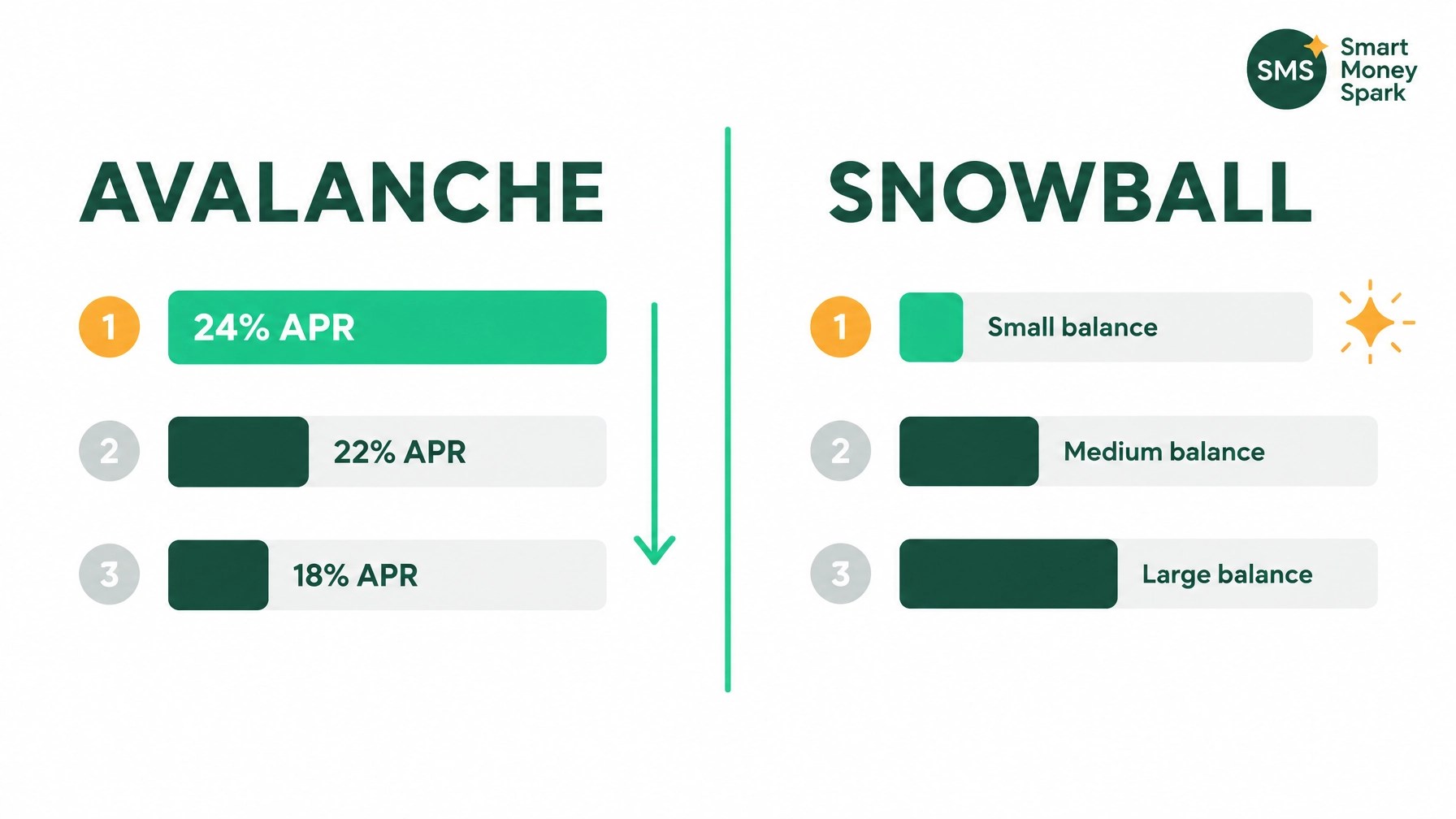
Avalanche orders debts by interest rate; snowball orders them by balance size.
Avalanche: target the highest APR first
The avalanche method directs your extra payment to the card with the highest APR, regardless of its balance. Once you pay it off, move that extra payment to the next-highest-rate card.
Because a higher APR generally adds interest faster, this approach is designed to reduce the total interest you pay. It can feel slow if the highest-rate card also has a large balance, so track progress by the balance going down, not just by the number of accounts paid off.
Snowball: target the smallest balance first
The snowball method directs your extra payment to the card with the smallest balance, regardless of APR. After you clear it, apply its payment to the next-smallest balance.
Paying off a card early can give you a visible win and simplify your monthly bill list. The trade-off is that you might leave a higher-rate balance to collect interest while you focus on a smaller one. The CFPB notes that this can mean paying more overall than using the highest-rate method.
What does the current credit card interest rate mean for your payoff?
The Federal Reserve’s November 6, 2026, G.19 Consumer Credit release, which reports September 2026 data, lists an average 21.19% APR for all credit card accounts and 22.36% for accounts assessed interest. The first figure averages stated rates across accounts; the second relates to accounts that were charged interest. These are national averages, not a quote for your card, check your statement or account for your actual APR.
That rate helps explain why minimum-only payments can stretch out. It also makes a fixed monthly payment above the minimum valuable: you pay down more of the balance instead of letting interest absorb much of your payment.
If you’re looking for room in your budget, Smart Money Spark’s comparison of seven budgeting methods can help you find an approach that fits your habits. Keep some accessible savings for unexpected costs, too. Our cash sweep versus high-yield savings account comparison explains how those cash options differ.
Worked example: a $6,000 balance at an illustrative rate
Here’s a simplified example using a 22.36% APR, the Federal Reserve’s September 2026 average for accounts assessed interest, as an illustrative rate, not a claim about your personal card rate. Assume no new purchases or fees, a fixed monthly rate of APR divided by 12, and payments made monthly. Actual card interest is usually based on daily balances, so your statement results can differ.
For the minimum-payment comparison, assume the payment is the greater of $25 or 1% of the balance plus that month’s interest. This is an example formula; issuers use different minimum-payment terms. The fixed-payment option pays $250 per month, with a smaller final payment.
| Payment approach | Estimated payoff time | Estimated total interest |
|---|---|---|
| Minimum-payment formula above | About 249 months (20 years, 9 months) | About $10,100 |
| Fixed $250 per month | About 33 months | About $2,030 |
Under these assumptions, the minimum-payment plan costs about $8,080 more in interest than paying $250 monthly. The long timeline is an illustration, not a prediction: your actual APR, minimum formula, due dates, and new charges all affect the result.
Even if $250 is too much, choose a fixed amount above the minimum that you can sustain. A steady payment you can make each month is more useful than an ambitious target that causes you to miss payments.
Avalanche versus snowball on three balances
The order changes when cards have different balances and rates. For example, assume these three balances:
| Card balance | APR | Snowball order | Avalanche order |
|---|---|---|---|
| $1,000 | 18% | 1st | 3rd |
| $2,000 | 24% | 2nd | 1st |
| $3,000 | 22% | 3rd | 2nd |
With the snowball, you target the $1,000 balance first, then $2,000, then $3,000. With the avalanche, you target the $2,000 balance at 24% first, then $3,000 at 22%, and finally $1,000 at 18%. In both cases, pay the minimum on the other cards and send your extra payment to the current target. The exact interest difference depends on your payment amount and card terms.
When the avalanche wins
Choose the avalanche when minimizing interest is your top priority and you can stay motivated without quick account payoffs. It is especially appealing when one card’s APR is much higher than the others, because extra payments go toward the balance where interest is generally most costly.
Make progress visible in another way: record each balance monthly, or track the amount of principal you’ve paid off. If a very small balance is distracting you, you could clear it first and then switch to the avalanche, but that choice may add some interest.
When the snowball wins
Choose the snowball when early wins will make it easier to stick with the plan. Paying off a small balance can simplify your bills and free up its minimum payment to roll into the next target.
The trade-off is worth considering: a larger balance with a higher APR may remain unpaid longer. The snowball is not automatically cheaper, but a plan you follow may work better for you than a lower-interest plan you abandon.
Which method should you choose? Three questions
- Is minimizing interest your main goal? Start with the highest-APR card and use the avalanche.
- Do you need a fast win to stay engaged? Start with the smallest balance and use the snowball.
- Can you keep making every minimum payment while paying extra? If not, first review your budget, contact your card issuer to ask about hardship options, and consider speaking with a nonprofit credit counselor.
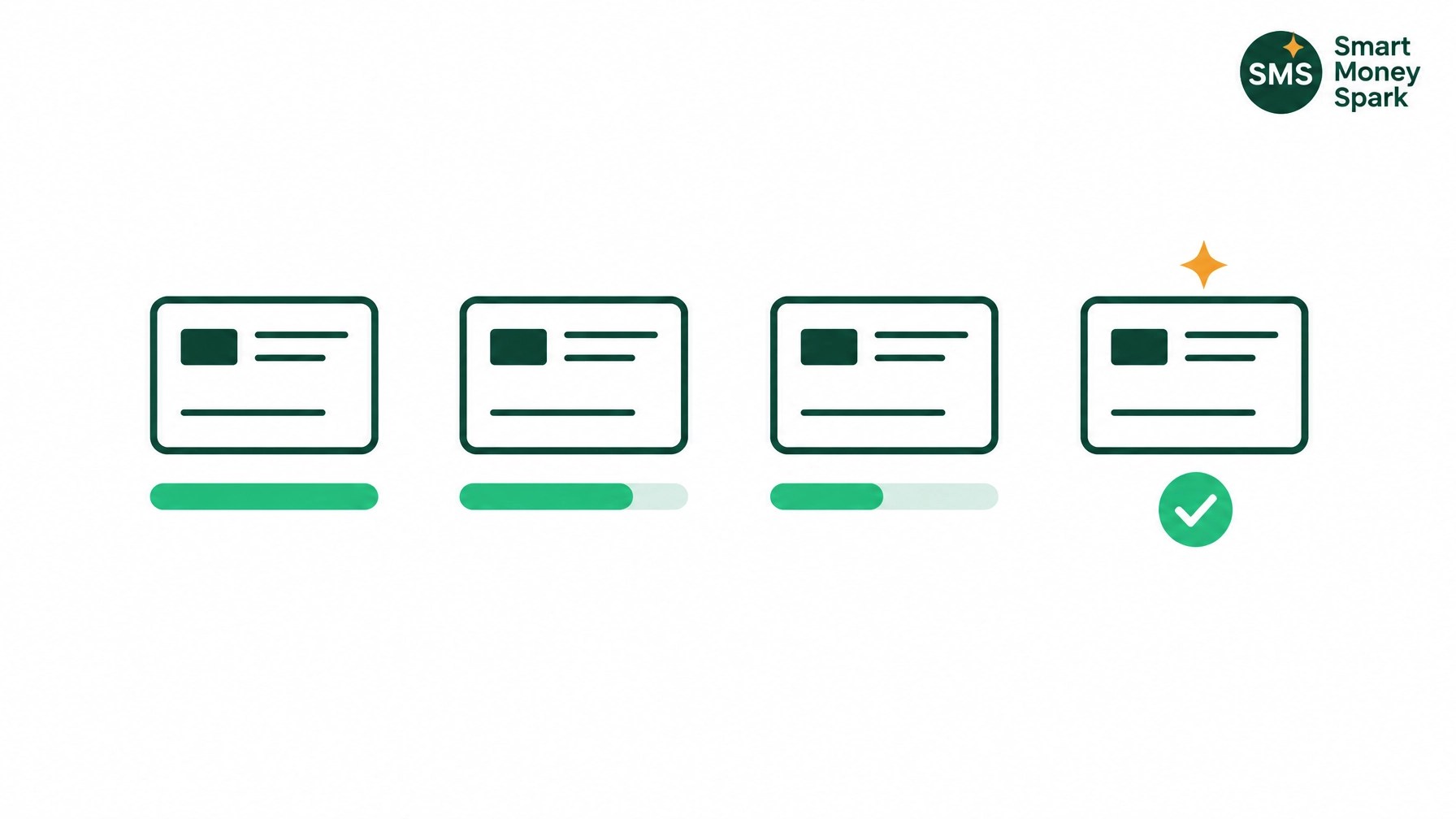
Each payoff frees up its minimum payment, which rolls onto the next target.
Rule of thumb: Choose the avalanche if you’ll stick with it; choose the snowball if quick progress makes you more likely to keep going. Whichever you choose, pay minimums on all cards and focus extra money on one target at a time.
Credit card payoff questions people actually ask
Can I switch from snowball to avalanche?
Yes. You can clear a small balance for momentum, then direct extra payments to the highest-rate card. Keep paying at least the minimum on every account throughout.
Should I save money or pay off a credit card first?
Consider keeping a modest cash buffer for urgent expenses while making minimum payments on time and paying extra toward debt. If you use every dollar on the card, an unexpected bill may push you back into borrowing. The right balance depends on your income, costs, and how much savings you already have.
Does paying more than the minimum lower my interest?
It generally helps because a larger payment can reduce the balance on which future interest is charged. The amount you save depends on your APR, payment timing, and card terms.
What if I can’t afford the minimum payment?
Contact the card issuer as soon as possible, before you miss a payment, and ask about hardship options. You can also seek guidance from a nonprofit credit counselor. Avoid taking on another costly loan without comparing its fees, rate, and repayment terms.
Key takeaways
- Pay at least the minimum on every card and direct extra money to one target.
- Avalanche prioritizes the highest APR and is designed to reduce interest.
- Snowball prioritizes the smallest balance and can provide quicker wins.
- A fixed payment above the minimum can shorten repayment substantially.
- Check your own APR and minimum-payment terms; averages and examples are not personal quotes.
Next step: Write down each card’s balance, APR, minimum, and due date today. Pick either the highest-rate or smallest-balance target, set up minimum payments, and decide on a fixed extra amount you can keep paying.
Smart Money Spark’s financial education draws on Corey Friedrich’s background in mortgage, real estate, and consumer financial education, with a practical local perspective.
This is educational information, not individualized financial advice.
Sources: Federal Reserve G.19 Consumer Credit release, November 6, 2026 · CFPB: How to reduce your debt · CFPB debt reduction worksheet