

If you’re asking what is a recession, you may also be wondering whether it means trouble for your paycheck, savings, or investments. The word can sound like a warning about what’s next, but it describes a broad decline in economic activity, not a guarantee about what will happen to your household.
In plain English, a recession is a sustained downturn affecting many parts of the economy. In the United States, the National Bureau of Economic Research (NBER) decides when one has started and ended, often after the turning point has passed. For your finances, preparing for possible income disruption and keeping investment choices aligned with your time horizon matter more than trying to predict the announcement.
What is a recession, exactly?
The NBER’s traditional definition is “a significant decline in economic activity that is spread across the economy and that lasts more than a few months.” Its Business Cycle Dating Committee weighs depth, diffusion, and duration: how severe the decline is, how widely it reaches across the economy, and how long it lasts.
There is no fixed rule for which indicators count or how much weight each receives. The committee reviews monthly measures such as real personal income less transfers, nonfarm payroll employment, real personal consumption expenditures, manufacturing and trade sales adjusted for price changes, household-survey employment, and industrial production. It also considers quarterly measures, including real GDP and real gross domestic income.
| Common shorthand | What it says | What the NBER does |
|---|---|---|
| Two quarters of falling GDP | Looks at one broad economic measure | Considers multiple indicators and monthly data |
| A falling stock market | Tracks share prices | Dates declines in economy-wide activity |
| Rising unemployment | Tracks labor-market conditions | Considers employment alongside other data |
GDP, or gross domestic product, is the total value of goods and services a country produces. “Two consecutive quarters of falling GDP” is a common shorthand, not the official definition. The NBER notes that the 2001 recession did not include two consecutive quarters of declining real GDP. GDP can help describe the economy, but no single figure automatically determines a recession.
Why does a recession date arrive after the downturn?
The NBER dates recessions retrospectively. It waits for enough information to judge whether a turning point occurred and allows time for economic data to be revised. That means an official announcement is not a live alert you can use to time your finances.
The National Bureau of Economic Research’s own explanation of how it dates business cycles includes a table showing the gap can vary widely: it announced the February 2020 peak on June 8, 2020, four months later. It announced the March 1991 trough on December 22, 1992, 21 months later. Nobody rings a bell in real time, and by the time an announcement comes, the conditions it describes may already have changed.
History also shows recessions vary in length. NBER business-cycle dates show the contraction from December 2007 to June 2009 lasted 18 months, while the February 2020 to April 2020 contraction lasted two months. Across 1945–2020, the NBER says contractions averaged 10.3 months and expansions averaged 64.2 months. Those averages describe past cycles; they do not predict the length or timing of a future one.
What might a recession mean for your job?
A downturn can affect employers and industries differently. Some workplaces may cut hours, pause hiring, or reduce staff; others may be less affected. Your household’s exposure depends on factors such as your employer, line of work, and how much of your budget depends on one paycheck.
The unemployment rate is one data point, not a personal forecast. The Bureau of Labor Statistics reported that the U.S. unemployment rate was 4.1% in October 2026. And even after a recession officially ends, job conditions may take longer to improve: the NBER notes that unemployment kept rising for four months after the June 2009 trough, reaching 10.0% in October 2009.
That lag is one reason to focus on what you can control. Think through which expenses you could reduce, what benefits or paid leave you may have, and how you would handle a temporary drop in household income. You do not need to know when a recession will be declared to make that plan.
Why can an emergency fund matter more than a forecast?
An emergency fund gives you money to cover essential expenses if your income falls or an unexpected bill arrives. It can help you avoid relying on high-interest debt or selling investments at a bad time. A useful starting point is to list essential monthly costs (such as housing, food, utilities, transportation, and insurance) and decide what reserve fits your income stability and responsibilities.
Keep money you may need soon somewhere accessible and relatively stable, such as an appropriate savings account. Compare access, rates, and protections before choosing where to keep it; our comparison of a brokerage cash sweep and a high-yield savings account explains some differences.
You may not be able to build a full reserve quickly. Start with a manageable amount, automate a regular transfer if your budget allows, and review the plan when your income or expenses change. The goal is a buffer that supports your actual household, not a number based on a recession prediction.
What can a recession mean for your portfolio?
A recession and a falling stock market are related possibilities, but they are not the same thing. Stock prices can drop without an official recession, and markets do not necessarily wait for an announcement before moving. For example, S&P Dow Jones Indices’ S&P 500 fact sheet reports a calendar-year price return of -19.44% in 2022. That figure is one year’s index performance, not a prediction for your investments.
Selling after a decline can turn a temporary paper loss into a realized loss. If you sell and later buy back at higher prices, you may miss some of a recovery. But staying invested only makes sense for money that fits your plan and time horizon; investments can fall further, and past recoveries do not guarantee future results.
If you want to understand what a broad index fund holds before deciding how it fits your portfolio, see our guide to what an index fund actually owns. A fund’s holdings and risks depend on what it tracks.
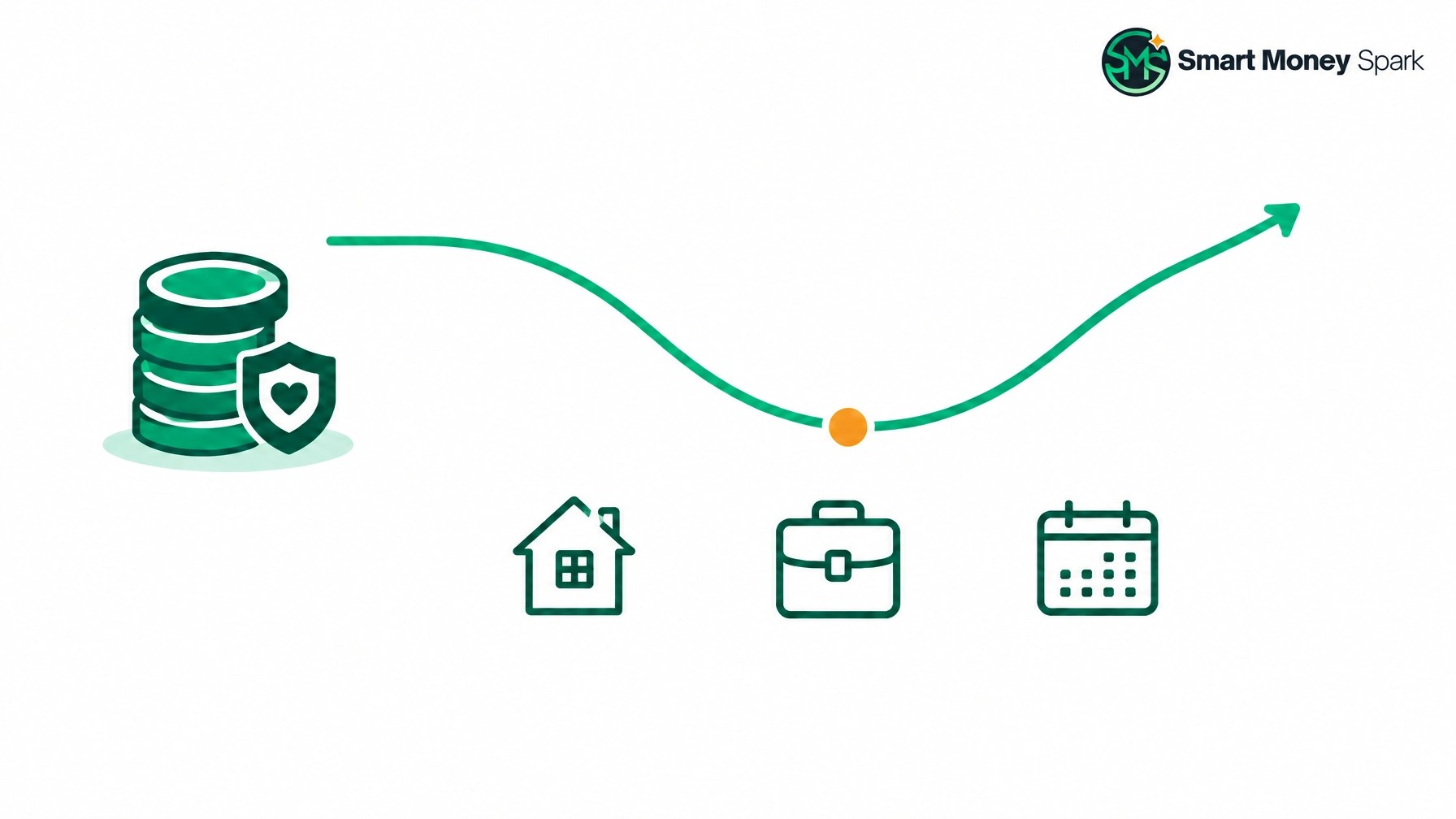
A $40,000 portfolio through an illustrative 20% decline
This example shows how different choices affect the arithmetic; it is not a forecast. A $40,000 portfolio falls by an illustrative 20% over six months to $32,000. If the market then recovers by an illustrative 25% over the next 12 months, the original invested balance returns to $40,000.
| Illustrative path during the 12-month recovery | Approximate value |
|---|---|
| A. Keep investing $500 a month | $46,660 |
| B. Leave the balance invested, adding no money | $40,000 |
| C. Sell at $32,000 and hold cash at 3.5% | $33,140 |
The $500 monthly contributions in Path A are assumed to be invested through the recovery. Path C applies an illustrative 3.5% cash yield for 12 months. The 20% decline, 25% recovery, contribution, and cash yield are all illustrative round numbers chosen to show the mechanics, not a forecast. Taxes and real market paths are messier, and the result will depend on the timing of contributions and returns.
When staying invested wins
Staying invested can make sense when your goals are long-term, your portfolio matches your risk tolerance, and you do not need the money soon. Continuing regular contributions during a decline buys more shares at lower prices, but it cannot prevent losses or guarantee a recovery on your schedule.
When cash wins
Cash can be the better fit for near-term spending, emergency savings, or a goal where a market drop would disrupt your plans. Keeping more in cash may reduce exposure to investment losses, but it can also mean lower growth over time. Match the account to when you need the money, rather than treating cash as a way to call the market’s next move.
What should you check before changing your plan?
Ask yourself three questions:
- Could you cover essential bills if your income paused or fell?
- When will you need the money you have invested?
- Would your current mix of investments and cash still fit if markets dropped further?
Rule of thumb: Keep near-term needs and emergency money accessible, and invest long-term money according to a plan you can stick with through both declines and recoveries.
What Is a Recession? FAQs
Does two quarters of falling GDP mean the U.S. is in a recession?
Not automatically. It is a common shorthand, but the NBER considers multiple indicators and notes that the 2001 recession did not include two consecutive quarters of declining real GDP.
Who officially dates U.S. recessions?
The NBER’s Business Cycle Dating Committee identifies the dates of economic peaks and troughs. It typically makes those decisions after the events, once enough data are available.
Do jobs always recover when a recession ends?
No. Employment can continue to weaken after an official trough. After the June 2009 trough, unemployment kept rising for four months and peaked at 10.0% in October 2009, according to the NBER.
Should you sell investments when a recession is announced?
An announcement alone does not tell you what to do. Consider when you need the money, your risk tolerance, and whether your portfolio still fits your plan before making a change.
Key takeaways
- A recession is a broad, significant decline in economic activity, not simply a stock-market drop.
- The NBER weighs depth, diffusion, and duration; it does not rely on a fixed two-quarter GDP rule.
- Recession dates are announced later, so they are not a real-time signal for financial decisions.
- Job-market effects may continue after an official recession ends.
- An emergency fund can help you avoid selling long-term investments to cover short-term needs.
Next step: List your essential monthly expenses, check how much accessible savings you have, and review when you expect to use the money in your investment accounts.
This article is general educational information, not individualized financial advice.
Sources: NBER: Business Cycle Dating Procedure FAQs · NBER: Business Cycle Dating · BLS: The Employment Situation · S&P Dow Jones Indices: S&P 500