

For every age group, the median retirement balance sits well below the average, so the typical household has saved far less than the headline number suggests.
That gap is the first thing to understand about any average retirement savings by age chart. The figures below come from the Federal Reserve's newest survey, and they are a starting point rather than a score you have to beat.
Average retirement savings by age: the 2025 benchmark
The table below shows the average retirement savings by age alongside the median for the same group. Both columns describe retirement account balances among families that actually have one, and the distance between the two numbers is the part worth understanding.
For most people, the median is the more useful comparison. A small number of very large balances can pull the average much higher than what a typical saver holds.
| Household age | Median balance | Average balance |
|---|---|---|
| Under 35 | $21,000 | $48,400 |
| 35–44 | $61,200 | $182,400 |
| 45–54 | $133,000 | $415,800 |
| 55–64 | $239,000 | $670,200 |
| 65–74 | $257,000 | $767,600 |
| 75 and older | $257,000 | $798,700 |
The Federal Reserve’s 2025 Survey of Consumer Finances, released in October 2026, reports these median and average balances among families that actually held a retirement account. Across all such families, the median was $106,000 and the average was $451,100. In 2025, 54.9% of all families held a retirement account, so the table does not include families with no account balance.
Why median and average tell different stories
The median marks the midpoint: half of account-holding families had more saved, and half had less. The average, also called the mean, adds all balances and divides by the number of families. A relatively small number of very large balances can pull that figure up, making it a poor picture of what a typical family has saved.
That gap is especially clear for ages 55–64. The average balance is nearly three times the median. If your balance is below the average, that alone does not tell you whether you are on track. Your spending needs, expected retirement age, income, pension or Social Security benefits, and the amount you can save all matter.
These are account balances, not a complete measure of retirement resources or a recommended savings target. They also describe families, not individuals, and balances vary with earnings, household circumstances, and years of saving. Use the figures to ask useful questions, not to judge your progress.
A worked example: how contributions, time, and fees add up
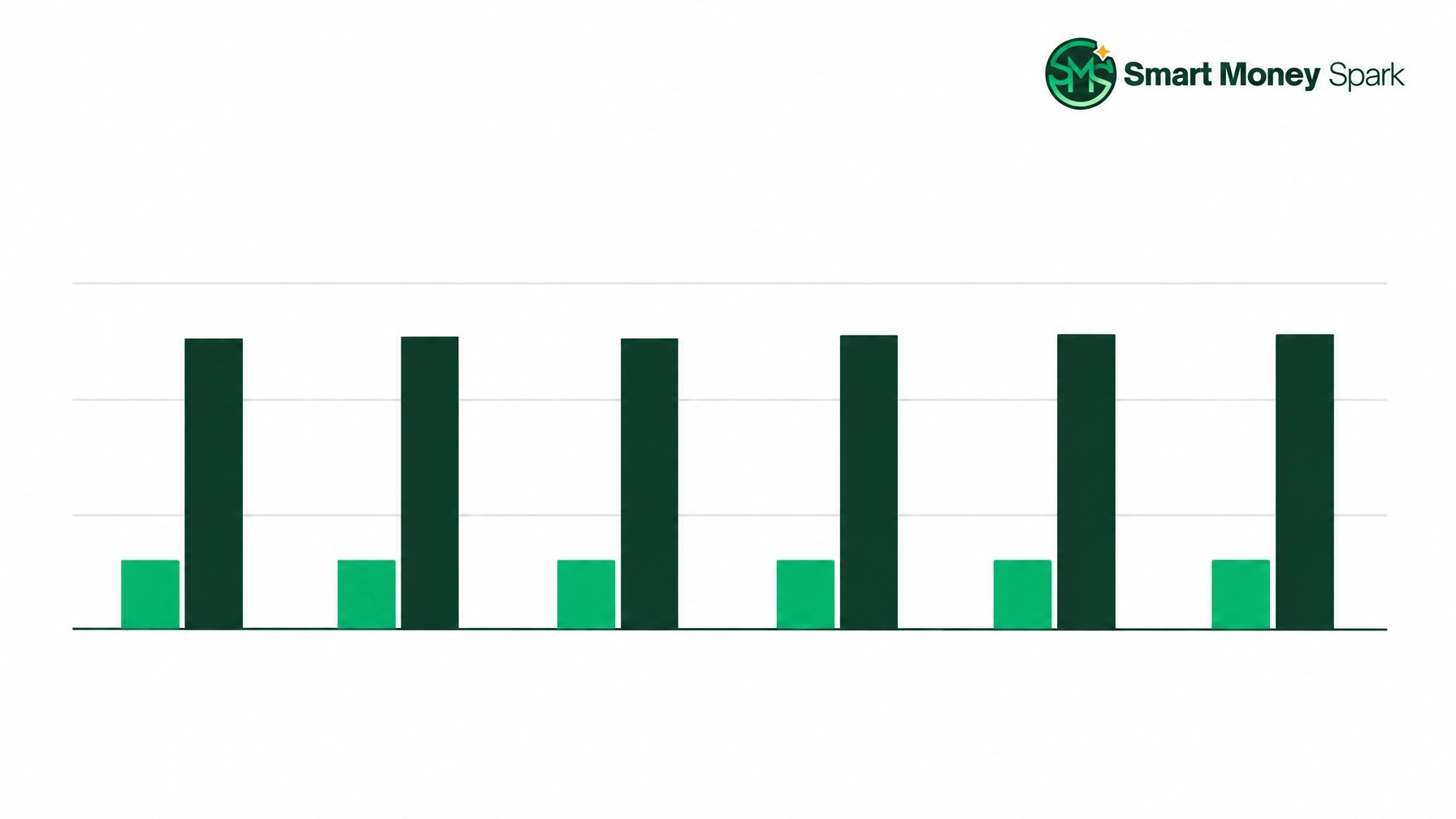
Consider a 40-year-old with $45,000 saved who contributes $600 each month. They earn $80,000 and receive a 3% employer match, adding $200 monthly. That brings total monthly deposits to $800.
The estimates below assume the existing $45,000 stays invested and monthly contributions continue through age 65, except where the row specifies a later start or different return. “Contributed” refers to new monthly deposits, excluding the $45,000 starting balance.
| Scenario | Monthly deposits | Total new contributions | Approximate value at 65 |
|---|---|---|---|
| 25 years at $600 monthly, no match | $600 | $180,000 | $617,000 |
| 25 years at $600 plus a $200 match | $800 | $240,000 | $755,000 |
| 20 years, starting at 45, $800 monthly | $800 | $192,000 | $519,000 |
| 25 years at $800 monthly, higher annual fee | $800 | $240,000 | $722,000 |
The 6% and 5.75% average yearly returns are illustrative assumptions, compounded monthly, to show how the math behaves. They are not forecasts. In the fee example, the annual fee is 0.25 percentage point higher, reducing the illustrative return from 6% to 5.75%. That difference leaves the account roughly $33,000 lower in this example.
The match adds $60,000 in deposits over 25 years, before considering investment growth. Starting five years later also changes the outcome, even with the same monthly deposits. And fees matter because they reduce what stays invested and can compound over time. None of these examples predicts what an actual account will earn.
Four levers you can still influence
You cannot change how much time has already passed, and investment returns are uncertain. But you can review your savings rate, employer match, investment costs, and whether your money is invested in a way that fits your timeline and comfort with risk.
Contribution rate: Set a sustainable amount, then consider increasing it gradually when your income rises or expenses fall. Even a modest increase adds more of your own money to the account, and that money may have more years to grow.
Employer match: Check your plan’s match formula and contribute enough to receive the full match if your budget allows. A match is an employer contribution tied to your own deposits, subject to plan rules.
Fees: Check your plan statement or fund documents for investment and account fees. An expense ratio is the yearly percentage a fund charges to manage your investment. Compare similar options in your plan, considering both cost and what each investment holds.
Time and investment mix: Saving earlier gives contributions more time in the market, though returns vary and losses can happen. Review whether your investment mix makes sense for your goals and time horizon rather than chasing recent performance.
2026 contribution limits and the value of a match
The IRS announced the 2026 limits in November 2025 under Notice 2025-67. The employee contribution limit for 401(k), 403(b), and most 457 plans is $24,500. For people age 50 and over, the standard catch-up contribution is $8,000, for a total of $32,500. Catch-up contributions are extra amounts people 50 and over can add on top of the normal limit. For ages 60, 61, 62, and 63, the higher workplace-plan catch-up limit is $11,250.
The 2026 IRA limit is $7,500, with an additional $1,100 catch-up for people age 50 and over, for a total of $8,600. Eligibility, plan rules, and tax treatment can vary, so check the details that apply to you. You can review the 2026 retirement limit changes and compare tax treatment in our Roth IRA versus Traditional IRA comparison.
A higher annual limit does not mean you need to contribute the maximum. Start with a savings amount that fits your budget, then consider raising it when you can. If you are age 50 or older, catch-up limits may provide additional room to save.
Vanguard’s How America Saves 2026, based on 2025 plan data, says the most common match formula was 50 cents per dollar on the first 6% of pay, offered by 12% of plans with a match. The average promised match was 4.7% of pay, and the median was 4.0%. With a 50-cent match for each dollar you contribute up to a set share of pay, the employer contribution is an immediate 50% return on that part of your contribution, before any investment growth. Your own plan’s formula may differ, so check the terms and any vesting rules.
When contribution increases win
Increasing contributions can be especially useful when your current savings rate is low or your employer offers a match you are not receiving in full. More money goes into the account, and a match can add to your deposits. If a large increase feels difficult, raise your contribution in smaller steps and review your budget as you go.
When lower fees win
Reviewing fees can help when you are already saving consistently and have access to comparable investment options with different costs. A small fee difference may compound over a long period, but do not choose an investment on price alone. Compare the fee alongside diversification, risk, and how the investment fits your plan.
When starting earlier wins
Time is the lever that quietly does the most work, because every extra year keeps your existing balance and its growth in the account. In the example above, the same $800 a month starting at 40 instead of 45 ends with roughly $237,000 more at 65, even though only five more years of deposits were added. If you are younger than you feel you should be, that is the reason to start now rather than wait for the perfect amount.
Three questions to guide your next move
- Am I contributing enough to receive my full employer match? Read the plan’s match formula and check whether you need to contribute a specific amount from each paycheck.
- Can I increase my contribution without squeezing essential expenses? Look at your take-home pay and recurring bills, then choose an amount you can maintain.
- Do I understand what I pay in fees and how my account is invested? Review plan statements and fund information, and compare investments with similar goals and risk.
Rule of thumb: First, aim to receive the full employer match if you can afford to contribute enough. Then choose a sustainable contribution level and review your fees and investment choices. Adjust the plan as your income, expenses, and goals change.
Frequently asked questions
Is the median or average a better retirement savings benchmark?
The median is generally a better guide to the typical account holder because a few very large balances can pull up the average.
Do these figures include families with no retirement account?
No. The balance figures cover only families holding a retirement account. The Federal Reserve reports that 54.9% of families held one in 2025.
What if I am behind the median for my age?
A lower balance than the median does not mean you are doomed. The biggest factor you can still influence is how much goes into your account from here, along with capturing any available employer match and reviewing fees.
How much should I contribute in 2026?
There is no single amount that fits everyone. Check your budget, employer match, account options, and the applicable IRS limits, then pick a sustainable contribution amount.
Key takeaways
- The median is usually more representative of a typical account-holding family than the average.
- The Federal Reserve’s age figures exclude families without a retirement account.
- Contribution rate, employer match, fees, and time can all affect your balance.
- A benchmark is context, not a personal retirement target or a verdict on your progress.
- Someone behind a benchmark is not doomed; future contributions are a major lever still available.
Next step
Check your latest retirement account statement and workplace plan match formula today, then choose one affordable action to improve your savings rate or understand your costs.
This is educational information, not individualized financial advice.
Sources: Federal Reserve’s 2025 Survey of Consumer Finances, IRS 2026 limit announcement, and Vanguard’s How America Saves 2026.