
Most advice aimed at Roth IRA for beginners opens with a wall of rules about income limits, five-year clocks, and contribution deadlines. Those rules matter, but they are rarely the part that trips people up.
The part that trips people up is what happens after the account exists. A Roth IRA is a retirement account you fund with money you have already paid tax on, and qualified withdrawals, including growth, come out tax-free. It is a container, not an investment. You still have to choose what to own inside it.
Roth IRA for beginners: what are you actually opening?
The short answer is a tax wrapper around investments you pick yourself. Contributions go in after tax, so there is no deduction this year, and qualified withdrawals later come out tax-free. The account on its own does nothing.
| Feature | Roth IRA | What it means for you |
|---|---|---|
| Contributions | After-tax money | No deduction for the contribution |
| Qualified withdrawals | Tax-free | Includes eligible investment growth |
| What you own | Investments you choose | The account alone does not invest your money |
| Lifetime required withdrawals | None for the original owner | You are not required to take lifetime RMDs |
A “qualified withdrawal” follows IRS rules, including the five-year rule and an eligible reason. A required minimum distribution, or RMD, is a withdrawal the law requires from some retirement accounts. The original Roth IRA owner does not have to take RMDs during their lifetime.
A Roth IRA differs from a Traditional IRA mainly in when taxes are paid. For a plain-language side-by-side, see our Roth versus Traditional IRA comparison.
What's the difference between contributing and investing?
Contributing means putting money into the Roth IRA. Investing means using the money in the account to buy an investment, such as a fund. These are separate steps, and stopping after the first one is a common beginner mistake.
If you deposit $100 and take no further action, the money may sit in the account’s cash sweep, the provider’s default place for uninvested cash. The rate varies by provider and can be low, so check what your cash earns. A deposit alone does not give you the growth potential of an investment, and investments can lose value.
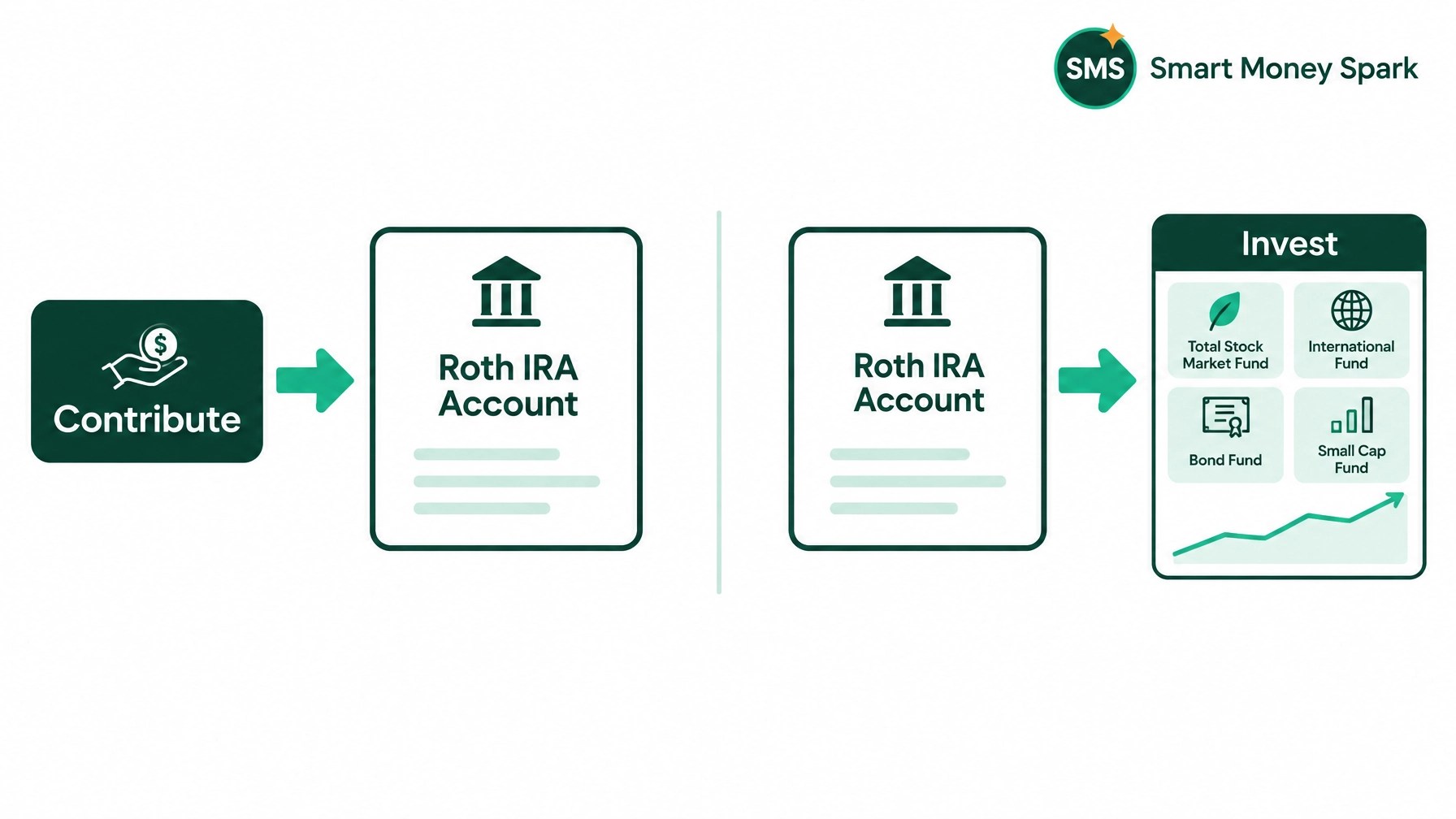
Once your contribution arrives, make an investment choice that suits your time horizon and comfort with ups and downs. A target-date fund is a single fund that usually adjusts its mix as a chosen retirement year gets closer. A broad index fund holds a wide group of investments and aims to track a market index. Both are common starting points, but neither is guaranteed to make money.
What could steady contributions add up to?
Here is an illustrative example of investing $200 a month for 30 years. It assumes a steady 6% average annual return, with monthly contributions and monthly compounding.
| Illustrative scenario | Amount |
|---|---|
| Monthly contribution | $200 |
| Contributions over 30 years | $72,000 |
| Approximate ending balance | $200,900 |
| Approximate growth | $128,900 |
The 6% return is only an illustration, not a forecast. Actual returns vary, can be negative, and are affected by investment choices, fees, and timing. The example does not include fees or taxes outside the Roth IRA.
What are the 2026 limits and who can contribute?
The IRS’s 2026 IRA limit announcement sets the annual contribution limit at $7,500, up from $7,000 in 2025. If you are age 50 or older, you may add a $1,100 catch-up contribution, for a total of $8,600.
That limit is shared across all your Traditional and Roth IRAs. You cannot put $7,500 into each type in the same year. You also generally cannot contribute more than your taxable compensation for the year, such as wages or self-employment income. Income eligibility rules apply to direct Roth contributions.
The IRS sets these 2026 Roth income phase-outs by filing status:
| Filing status | 2026 modified adjusted gross income range |
|---|---|
| Single or head of household | $153,000–$168,000 |
| Married filing jointly | $242,000–$252,000 |
| Married filing separately | $0–$10,000 |
A phase-out is an income range where the allowed contribution gradually shrinks. At the top of the range, direct Roth IRA contributions are unavailable. For married filing separately, the $0–$10,000 range applies if you lived with your spouse during the year; other situations may use different rules. Check your filing status and modified adjusted gross income, or MAGI, which is an IRS-adjusted income figure used for certain tax limits. For the wider set of workplace and IRA figures, see our guide to the 2026 retirement limits.
How do you open your first Roth IRA?
Before opening a separate account, check whether your employer offers a 401(k) match. A Roth IRA is not a substitute for an employer match, so aim to capture the match available to you first, if your budget allows.
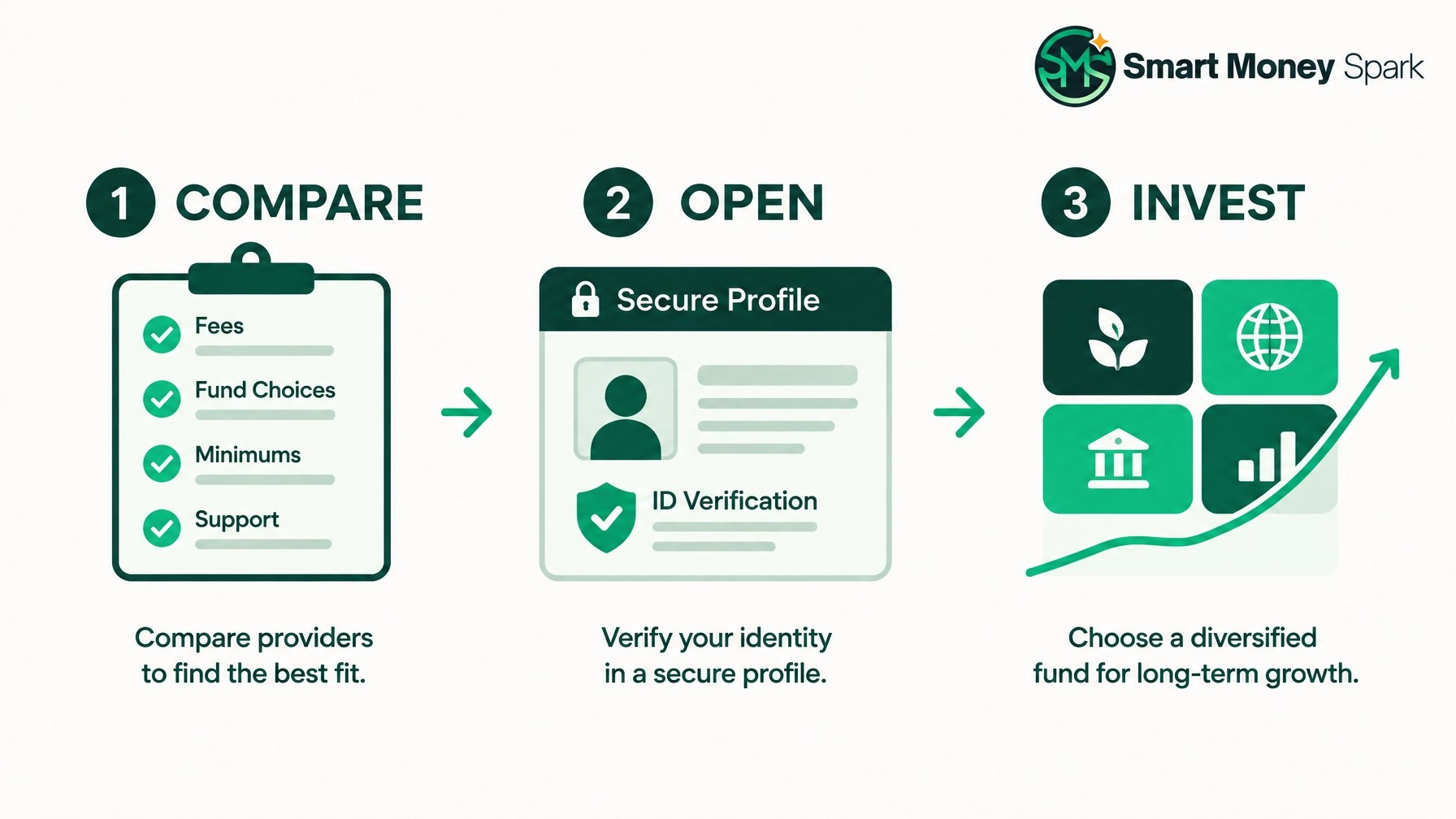
Then follow these practical steps:
- Compare providers. Look at account fees, available funds, minimums, and customer support. Check both account charges and fund costs. An expense ratio is the annual fee a fund charges as a percentage of your investment.
- Complete identity verification. Have your legal name, date of birth, Social Security number, and current address ready. Providers use these details to verify your identity.
- Link your bank account. Choose an initial deposit and a contribution amount that fits your budget. You can often set up recurring transfers, such as $25 or $50 each month.
- Choose an investment. Decide what to buy inside the account rather than leaving your contribution in cash by default. A low-cost target-date fund or broad index fund is a common starting point. Compare costs and make sure the fund’s risk level suits you.
- Check your setup. Confirm that your transfer is scheduled and your money is invested as intended. Review the account occasionally, but you do not need to react to every market move.
How does the five-year rule affect withdrawals?
The Roth IRA five-year clock starts on January 1 of the first tax year for which you made a contribution to any Roth IRA set up for your benefit. It does not restart just because you open another Roth IRA.
For earnings to come out tax-free, the withdrawal generally needs to meet the five-year requirement and a qualifying condition. The most familiar condition is reaching age 59½. Other qualifying reasons include disability, death, or a qualifying first-home withdrawal, subject to a $10,000 lifetime limit.
Your regular contributions are treated differently from earnings. You can generally withdraw the amount of your contributions at any time, tax-free and penalty-free. But withdrawing contributions can reduce the money you have invested for retirement, and earnings are subject to separate rules. If you take earnings before age 59½ and before meeting the five-year clock, they can be taxable and may face a 10% additional tax unless an exception applies. Read the IRS’s Publication 590-B, which explains Roth IRA distributions, before making a withdrawal.
When a Roth IRA wins
A Roth IRA can be appealing if you would rather pay tax on your contributions now in exchange for tax-free qualified withdrawals later. It can also suit you if you value the option to withdraw regular contributions without tax or penalty, though taking that money out can set back your retirement saving.
Where a Roth IRA falls short
A Roth IRA may be less useful if you need a current-year deduction, since Roth contributions are not deductible. Income limits can reduce or prevent direct contributions, and investment values can fall. If you have high-interest debt or lack an emergency reserve, consider your broader finances before locking more money into long-term savings.
How do you decide? (the simple rule of thumb)
Ask yourself these three questions:
- Have you checked your eligibility? Review your filing status, MAGI, taxable compensation, and contributions to any other IRAs.
- Does the tax timing fit? Consider whether paying tax now for the possibility of tax-free qualified withdrawals later fits your situation.
- Have you captured an available employer match? Check your workplace plan’s match and rules before prioritizing IRA deposits.
Rule of thumb: If you qualify, have captured an available employer match, and value tax-free qualified withdrawals later, a Roth IRA may be worth considering. If you are unsure how the tax trade-off affects you, compare the options using your full financial picture.
Roth IRA FAQs for beginners
Can you lose money in a Roth IRA?
Yes. The account is not an investment that prevents losses. The value depends on what you buy inside it, and investments can rise or fall. Cash may have a different risk and return profile from investment funds.
What happens if you contribute too much?
An excess contribution can trigger a 6% tax each year the excess remains. Contact your account provider and review the IRS correction rules promptly. The IRS’s IRA contribution limits page explains the shared limit and excess-contribution rules.
Do you have to invest the money right away?
You do not usually have to buy an investment immediately, but your contribution may sit in cash until you choose one. Check the account and make an investment choice if your goal is long-term investing.
Can you have a Roth IRA and a 401(k) at the same time?
Yes. Having a workplace retirement plan does not by itself prevent you from contributing to a Roth IRA. Roth income limits still apply, and the IRA limit is separate from the 401(k) limit.
Can you withdraw Roth IRA money whenever you want?
Regular contributions can generally be withdrawn at any time without tax or penalty. Earnings have additional rules, so check the IRS distribution guidance before taking money out.
Key takeaways
- A Roth IRA is an account, not an investment; choose what to own inside it.
- Contributions are after-tax, and qualified withdrawals, including growth, are tax-free.
- The 2026 IRA limit is $7,500, or $8,600 if you are 50 or older, shared across Roth and Traditional IRAs.
- Roth income phase-outs can reduce or end your allowed direct contribution.
- Regular contributions and investment earnings follow different withdrawal rules.
- Check for an employer match, compare account costs, and invest your contributions intentionally.
Next step: Check your 2026 filing status, MAGI, taxable compensation, and existing IRA contributions, then compare providers and set up a sustainable monthly transfer.
This is general information, not individualized financial, investment, tax, or legal advice.
Sources: IRS 2026 limit announcement, IRS Publication 590-B: Distributions from Individual Retirement Arrangements, IRS IRA contribution limits.